
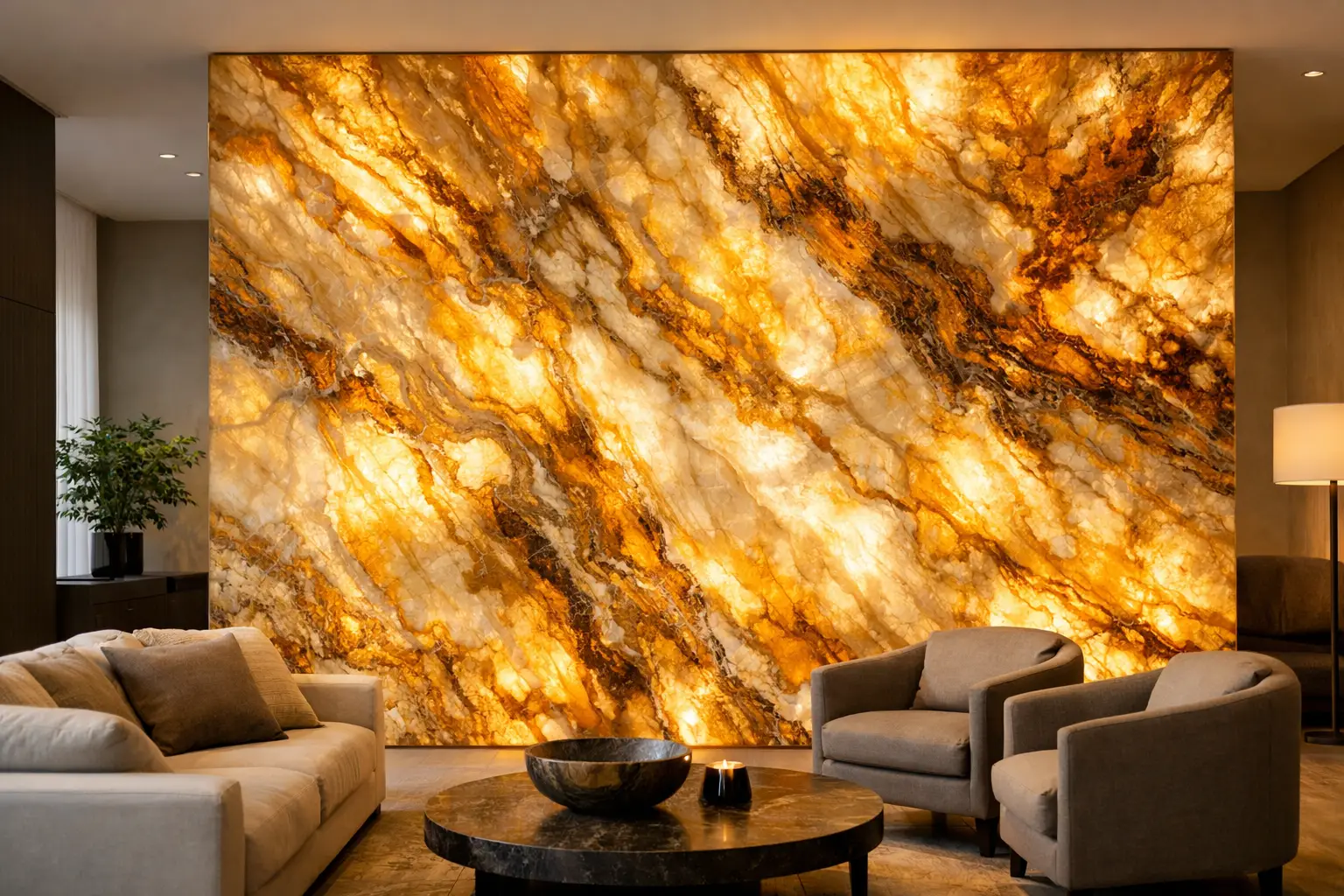
A backlit onyx feature wall does more than decorate a room. When the stone is illuminated from behind, its veining, crystalline movement and mineral depth become part of the architecture itself. What appears solid by day acquires a quiet radiance after dusk, creating an interior with presence, intimacy and unmistakable character.
For private residences, hospitality settings and distinguished commercial spaces, onyx offers a rare opportunity: light is not merely cast upon a surface, but held within it. The result can be theatrical or restrained, depending on the selected slab, the setting and the discipline of the installation.
Why onyx changes in the presence of light
Onyx is valued for its translucency. Unlike many stones that reflect light only from their surface, onyx allows a controlled degree of illumination to pass through its body. Its layers of calcite, formed over millennia, reveal veils of honey, ivory, tobacco, green, rose or deep amber. Each block carries an unrepeatable composition.
This is why a backlit installation should never be approached as a standard decorative panel. The same stone may feel serene in a pale, open-plan living area and dramatic in a private bar, reception hall or spa. A cloud-like white onyx can lend a room a soft, almost architectural glow. Richer varieties, marked by bolder veins and warmer tones, create an atmosphere closer to a work of art.
Light brings forward details that may remain discreet in ambient daylight: a fine mineral line, a darker vein that traverses the slab, or a gradual transition from translucent gold to opaque cream. The wall becomes a living composition, changing with the hour and with the level of illumination.
Designing a backlit onyx feature wall
The most successful projects begin with the slab, rather than an abstract finish palette. Natural stone does not repeat itself, and onyx requires careful selection before fabrication begins. Photographs can indicate colour and general movement, but they cannot replace an in-person reading of the material, particularly when translucency is central to the design.
A fabricator must consider how the individual slabs will sit together, where veins will meet and whether bookmatching will enhance the composition. In bookmatched work, two adjacent slabs are opened like the pages of a book, creating a mirrored pattern. This can lend a wall great symmetry and ceremonial balance, especially behind a reception desk, in a principal bathroom or around a fireplace.
Yet symmetry is not always the right answer. A single monumental slab may have greater force where the room calls for stillness. In another setting, a sequence of carefully aligned panels can give the impression of a continuous geological landscape. The proportions of the wall, the viewing distance and the surrounding materials all shape this decision.
Thickness, support and fabrication
To permit light transmission, onyx is often processed at a thinner thickness than stone used for conventional cladding. This demands precision. The stone must be sufficiently refined to reveal its translucency, while retaining the integrity required for transport, handling and long-term installation.
The supporting system is equally significant. A backlit stone wall is not simply fixed to a surface and illuminated afterwards. It is a composed assembly of stone, a structural or framed backing, lighting components, ventilation allowances, access points and carefully resolved joints. Every layer must be designed in relation to the others.
A clean visual result depends on exact fabrication. Edges, returns, recesses for switches or fittings, and the transition between stone and joinery all need to be settled before cutting begins. In luxury interiors, these apparently small decisions often determine whether the finished work feels considered or compromised.
Choosing the right illumination
Lighting should reveal the stone rather than compete with it. LED systems are generally favoured for their low heat output, controllability and long service life. Even illumination is essential: visible points of light, excessive brightness or shadowed areas behind the stone can diminish the effect of an exceptional slab.
The colour temperature deserves careful thought. Warmer light commonly brings out the honeyed, golden and reddish notes in onyx, creating an enveloping atmosphere suited to residential rooms and hospitality interiors. A more neutral temperature can suit pale white or green varieties where clarity and freshness are desired. There is no universal setting. The stone, the room’s intended use and the desired mood must be considered together.
Dimming is particularly valuable. At full intensity, a wall may become the focal point of an evening gathering or entrance sequence. Lowered later, it can remain a gentle source of ambience. The ability to adjust the light protects the design from becoming too insistent.
Where illuminated onyx belongs
A backlit onyx feature wall is often chosen for spaces where arrival, gathering or retreat matters. An entrance hall can be given immediate identity through a luminous stone surface, particularly when paired with bronzed metal, dark timber or restrained plasterwork. In a dining room, onyx can create a warm backdrop that enriches evening light without requiring excessive ornament.
In bathrooms and wellness areas, its effect is more intimate. A pale onyx wall behind a freestanding bath, vanity or shower enclosure introduces softness to materials that might otherwise feel cool and functional. Here, however, detailed attention to moisture management, sealing and access to technical components is indispensable.
For hotels, restaurants and private members’ spaces, illuminated onyx is often most persuasive at the bar, behind a reception counter or within a secluded lounge. These are settings where light is expected to shape mood and where the material can become part of the guest’s memory of a place.
It can also be used with great restraint. A narrow illuminated niche, a framed panel at the end of a corridor or an onyx-clad fireplace surround may offer more distinction than an entire wall. Scale is not a measure of luxury. Proportion, material quality and workmanship are.
The trade-offs behind the beauty
Onyx is a precious natural material, and its visual delicacy comes with practical considerations. It is generally softer and more sensitive than granite, and some varieties may be vulnerable to staining, scratching or etching from acidic substances. For this reason, it is usually better suited to vertical surfaces than to heavily used worktops or flooring.
Its appearance can also vary considerably across a slab. This variation is not a fault but the very reason onyx is sought after. Clients who want perfect uniformity may be better served by another material. Those who choose onyx are choosing the unexpected line, the clouded passage of colour and the singularity of geology.
Cost is shaped by several factors: the rarity and origin of the stone, slab selection, the degree of matching, specialist thinning and reinforcement, the lighting system, site conditions and installation complexity. A wall with large, continuous bookmatched panels will naturally demand more planning and material than a smaller composition. The value lies in treating the work as an enduring architectural element, not a replaceable finish.
Maintenance should be planned from the outset. A suitable sealant, gentle pH-neutral cleaning and the avoidance of abrasive products will preserve the surface. Equally, the lighting installation should allow for sensible inspection and servicing. A beautiful stone wall should remain a pleasure to own, not a technical concern hidden behind an inaccessible surface.
Craftsmanship from selection to installation
The journey from quarry to interior is one of interpretation. Selecting onyx requires knowledge not only of colour and vein but of the stone’s structural behaviour, translucency and response to cutting. Fabrication requires sensitivity to its fragility. Installation requires the calm precision to bring a demanding design into place without losing the intended alignment of the composition.
Since 1860, Torchio Marmi has approached natural stone as both a material of construction and a bearer of memory. This perspective is especially meaningful with onyx. No two slabs are identical, and no successful installation can be reduced to a catalogue solution. The finest result emerges when architecture, light, material and craftsmanship are brought into conversation.
Before choosing the final slab, stand before it under proposed illumination where possible. Observe its darker passages as carefully as its glowing ones, and consider the room in its quietest evening state. A backlit onyx wall earns its place when it continues to offer atmosphere long after the first impression has passed.