
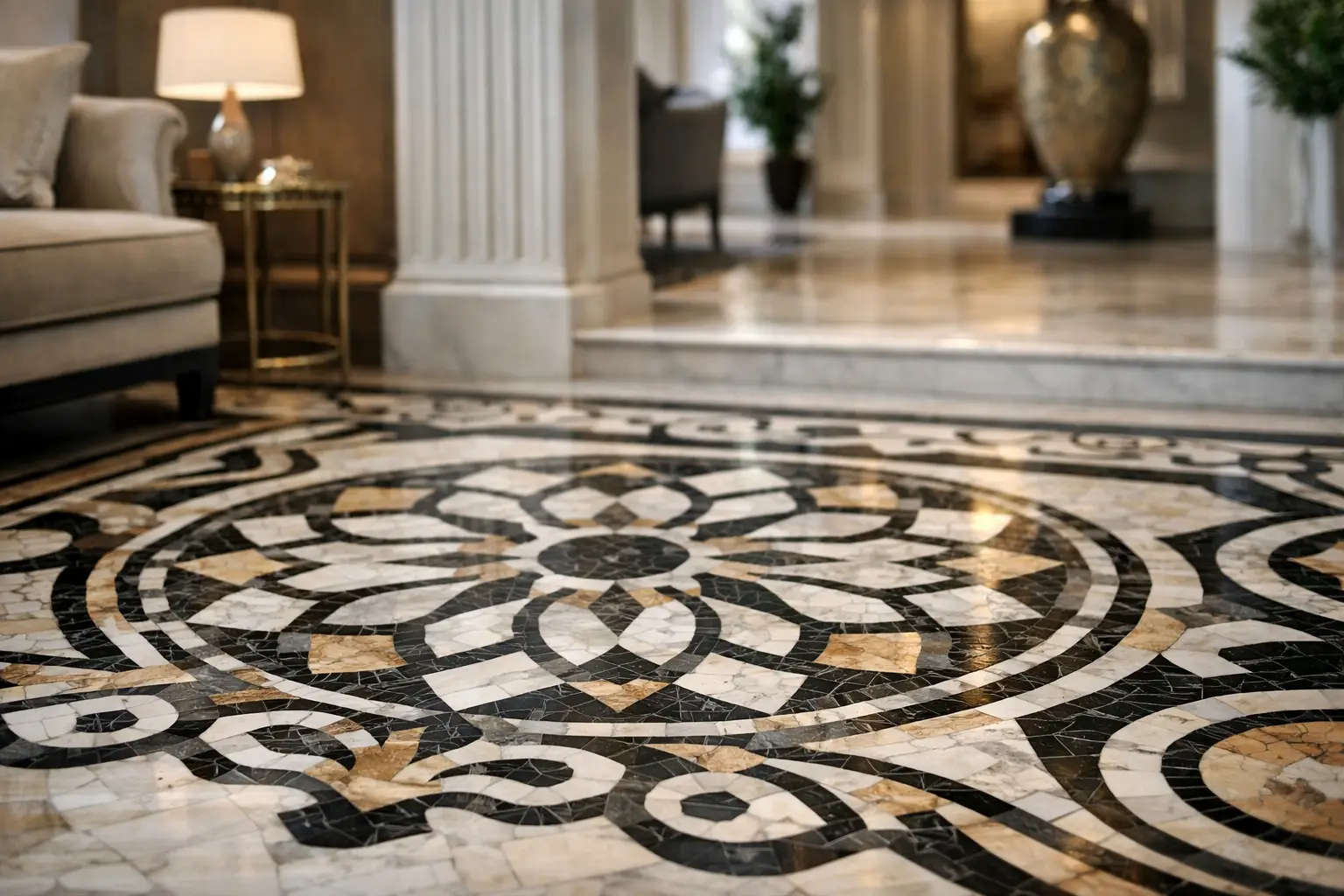
A well-made mosaic floor changes character with the hour. In morning light, its tesserae reveal a quiet geometry; by evening, polished marble gathers the warmth of the room and gives it back in softer tones. This guide to marble mosaic flooring is intended for those who see a floor not as a background finish, but as an architectural surface with the power to establish atmosphere, proportion and memory.
Marble mosaic has survived in villas, palazzi, sacred buildings and public halls because it brings together decorative freedom and material permanence. Yet its success depends on decisions made long before installation: the right stone, the correct finish, a pattern suited to its setting, and workmanship precise enough to let the design appear effortless.
Why marble mosaic flooring remains distinctive
Mosaic is composed of many small pieces of stone, known as tesserae, assembled into a continuous design. This construction permits a degree of detail that large-format slabs cannot always provide. A restrained field of white and grey can lend a hallway composure; a border in deep green, red or black can define a dining room; a complex geometric composition can give a reception space its own identity.
Unlike printed porcelain or manufactured imitations, marble carries natural variation in veining, crystallinity and tone. No two tesserae are identical. That variation is not a defect to be corrected, but part of the floor’s visual life. The craft lies in selecting and placing each element so that the natural movement of the stone serves the intended composition rather than distracting from it.
For heritage properties, marble mosaic can continue an existing language of materials with sensitivity. For contemporary interiors, it can introduce depth and permanence without relying on ornament for its own sake. The same material may feel classical, modern or quietly monumental depending on scale, palette and setting.
Choosing marble for a mosaic floor
The first question is not simply which colour is preferred, but how the floor will be used. An entrance hall, bathroom, kitchen, boutique hotel lobby and protected historic interior place very different demands on the stone and its finish.
White marbles such as Carrara create luminosity and work beautifully in both traditional and contemporary schemes. Their grey veining can be used as a gentle field or contrasted with darker stones for a graphic pattern. Calacatta and Statuario offer more pronounced movement and warmth, making them especially expressive in formal rooms where the floor is intended to hold attention.
Darker marbles bring gravity. Nero Marquina gives a defined black ground with pale veining, while green and red marbles can provide rich accents in borders, medallions and inlaid motifs. Travertine, onyx and selected natural stones may also enter a composition, though each requires consideration of its porosity, translucency and suitability for the intended traffic.
A well-balanced palette usually has a hierarchy. One stone leads, another supports, and a third is used sparingly to articulate a line or central detail. When every marble competes for attention, the floor can lose its calm. In a room with highly figured wall stone, ornate joinery or antique furnishings, a more restrained mosaic often gives the architecture room to breathe.
Finish, slip resistance and daily life
Polished marble reflects light and enriches colour, particularly in drawing rooms, bathrooms and ceremonial interiors. It also shows water marks, scratches and wear more readily than a honed surface. Honed marble has a softer, matt appearance and is often the wiser choice for kitchens, entrance spaces and areas used frequently by family, guests or staff.
In wet areas, finish and mosaic scale matter. Smaller tesserae create more grout joints, which can improve underfoot grip. This does not remove the need for considered detailing, appropriate drainage and sensible cleaning, but it helps make a beautiful material practical. A specialist should assess the location rather than applying one solution to every room.
Pattern and proportion: the heart of the design
The most enduring marble mosaic floors are drawn for the room, not selected from a generic sample board. The proportions of doors, windows, fireplaces, columns and thresholds should inform the design. A border that appears graceful in isolation may feel cramped once furniture and circulation are considered.
In a narrow corridor, a linear pattern can lengthen the perspective and lead the eye towards a focal point. In a square vestibule, a centred panel or modest rosette can create order. Larger rooms may accommodate repeated geometric fields, framed panels or decorative bands that establish distinct zones without introducing physical divisions.
Traditional motifs - guilloches, lozenges, stars, checkerboards and interlaced borders - possess a long architectural history, but they need not be reproduced literally. Their geometry can be simplified, enlarged or rendered in an unexpected tonal combination to suit a contemporary residence. Conversely, a period property may require close study of surviving fragments, historic photographs and adjacent materials before a restoration design is proposed.
Scale is decisive. Very small tesserae allow intricate curves and detailed figurative work, but they create a more visibly textured surface. Larger pieces give a quieter, more architectural reading. The right balance depends on viewing distance, room size and the role the floor is expected to play.
What expert installation involves
Marble mosaic rewards precision and exposes compromise. A beautiful selection of stone cannot compensate for an unstable substrate, poorly planned joints or imprecise setting-out. The floor must begin with a properly assessed base: level, dry, structurally sound and suitable for the specified adhesive, waterproofing system and underfloor heating arrangement where relevant.
Before fixing begins, the design should be set out from the principal visual axis rather than from whichever wall happens to be closest. In older buildings, walls are not always square, and thresholds may have shifted over time. Skilled installers reconcile these realities so that the pattern reads as balanced when viewed from the entrance or centre of the room.
Tesserae may be cut by hand or with specialist machinery according to the material and design. Curves, corner returns, borders and transitions require particular care. The grout colour must also be chosen with restraint: it can either sharpen the geometry or soften it into a near-continuous field. A poorly matched grout can flatten the richness of the marble or make a refined pattern look overly busy.
Movement joints, perimeter details and transitions to adjacent finishes are technical necessities, not interruptions to be ignored. They protect the floor as a building moves through seasonal temperature changes and everyday use. Where underfloor heating is planned, the entire assembly must be designed accordingly, with gradual commissioning after installation to avoid thermal shock.
At Torchio Marmi, this dialogue between drawing, material and site is central to every bespoke stone commission. The final work should appear inevitable within its surroundings, while concealing the many technical decisions that give it longevity.
Care that respects natural stone
Marble is durable, but it is not indifferent. Its calcium-rich surface can be etched by acidic substances such as wine, citrus juice, vinegar and harsh bathroom cleaners. Etching is a change in the stone’s finish rather than a conventional stain, and it is particularly visible on polished surfaces.
For routine care, use a pH-neutral cleaner formulated for natural stone, applied sparingly with a soft mop or cloth. Abrasive powders, bleach, acidic products and generic descalers should be avoided. In entrance areas, well-positioned mats reduce the grit that can gradually dull a polished finish. Spills should be attended to promptly, especially on pale or honed marbles.
Sealing can provide useful protection against absorption, but it does not make marble invulnerable and should never be treated as a substitute for appropriate care. The required treatment depends on the stone, finish and setting. A bathroom floor and a formal salon may call for different maintenance plans.
Restoration and the value of patina
Over time, a marble mosaic may acquire scratches, minor chips, worn grout or a softened sheen. Not every mark requires removal. In historic interiors, gentle patina can be part of the building’s truth, recording decades of movement and use. The task is to distinguish between honourable age and deterioration that risks the floor’s integrity.
Sensitive restoration begins with diagnosis. Loose tesserae, moisture migration, cracks in the substrate and incompatible past repairs should be addressed before cosmetic work. Replacement stone must be selected for its character as well as its nominal colour; a technically correct but visually unrelated piece can interrupt the entire composition.
Cleaning, regrouting, consolidation, honing or repolishing should be carried out only to the degree the floor needs. A historic mosaic should not be made to look newly manufactured if that would erase the depth that makes it significant.
A marble mosaic floor deserves to be commissioned with patience. Allow the stone, the architecture and the hand of the maker to establish a shared language, and the result can become more than a surface beneath one’s feet: a lasting part of the home’s character, ready to receive the life lived upon it.