
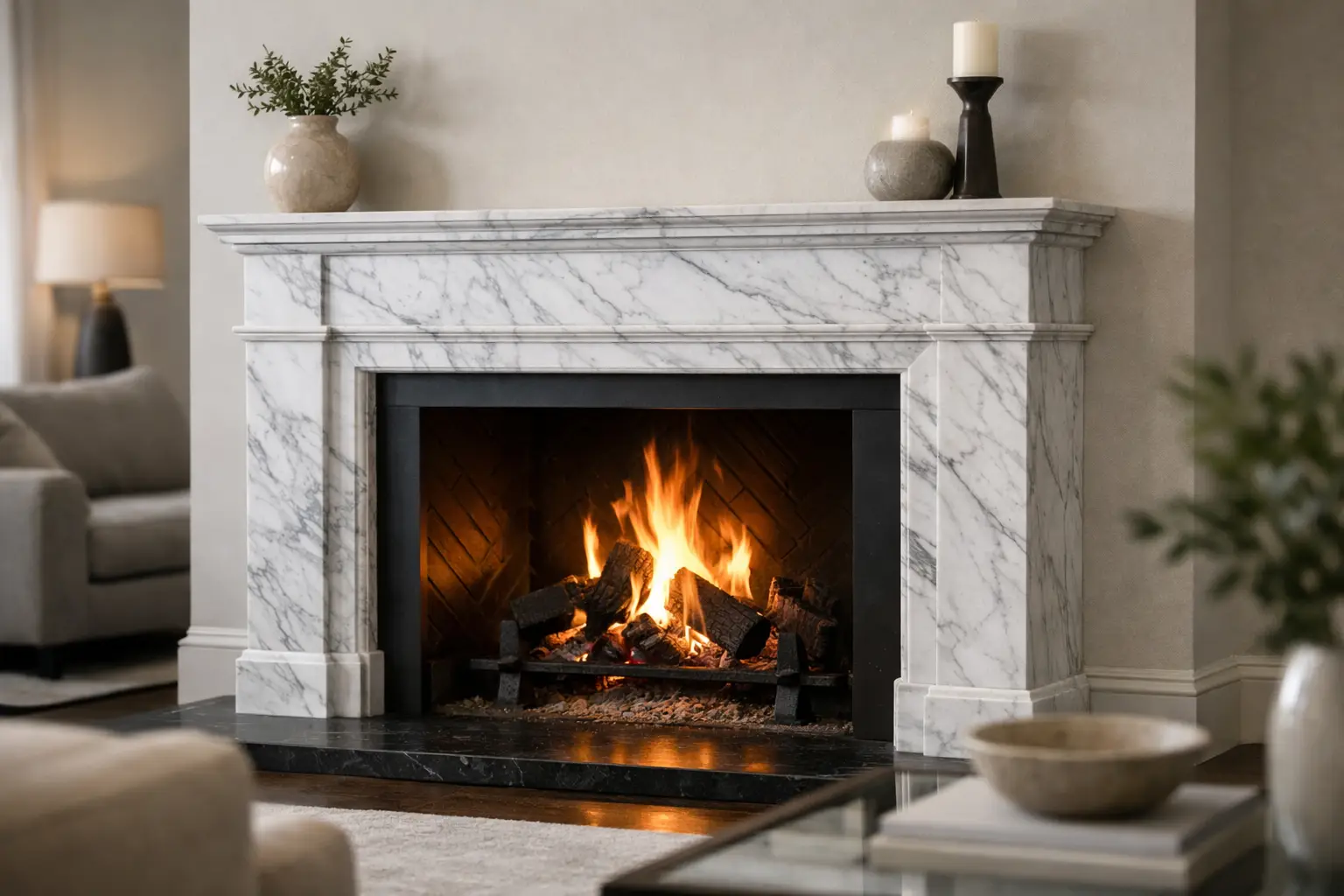
A fireplace is rarely only a source of heat. It is the point towards which a room settles: the place that receives conversation, candlelight, winter evenings and the small rituals of home. A bespoke marble fireplace surround gives this focal point a permanence that manufactured finishes cannot imitate, bringing the depth of natural stone and the discipline of considered proportion into a single architectural gesture.
For a period townhouse, a country residence or a contemporary flat with a restrained interior, the surround must belong to its setting. Its success lies not merely in choosing an impressive slab, but in understanding scale, light, vein direction, fire requirements and the character of the wider room. This is where custom stonework becomes design at the service of dreams.
Why marble changes the character of a fireplace
Marble has a presence that is at once composed and expressive. Formed over geological time, every block holds variation in veining, crystallisation and tone. Even a quiet white marble carries movement beneath the surface; a darker stone can bring extraordinary depth without making a room feel heavy.
Around a fireplace, this natural variation is especially meaningful. Flame and changing daylight reveal different notes in the stone throughout the day. The surround may appear cool and silvery in the morning, then warmer under lamplight. Unlike a printed or engineered imitation, marble does not repeat itself. It gathers character with use, becoming part of the memory of a house.
Its visual value, however, must be matched by technical knowledge. Marble is not a generic material. Different varieties respond differently to heat, staining, moisture and finishing processes. A fireplace surround should therefore be designed around the specific stone selected, rather than forcing every material into an identical profile or construction method.
Beginning with the room, not the catalogue
A successful bespoke marble fireplace surround begins with observation. Before discussing colours or decorative details, it is necessary to read the architecture. Ceiling height, chimney-breast width, adjacent joinery, flooring and sightlines all influence the right composition.
In a tall reception room, a compact surround can look hesitant, even if the marble itself is exceptional. In a lower-ceilinged space, an oversized mantel may dominate the room and interrupt its calm. The aim is proportion rather than grandeur for its own sake. A carefully measured opening, a mantel with the right projection and legs that meet the hearth with assurance can make the whole interior feel more resolved.
The fireplace type also guides the design. A working wood-burning fire, gas appliance, electric installation and decorative opening each have different technical demands. Clearances, ventilation, non-combustible construction and the manufacturer’s instructions must be considered from the outset. Beauty is never separate from safety or performance.
Choosing a language of form
The form of the surround should speak to the building without becoming a pastiche. A Georgian or Victorian interior may call for moulded jambs, a shaped shelf or carefully judged classical detailing. In a contemporary home, a monolithic opening in honed stone can create a quieter but equally powerful statement.
There is room for subtle dialogue between periods. A clean-lined Calacatta surround can sit beautifully against original cornices, while richly veined Arabescato may give a modern room the visual depth it lacks. What matters is that the design has a clear intention. Decorative complexity should be earned by the architecture; simplicity should be precise, not anonymous.
Selecting marble for colour, movement and use
No photograph can fully replace viewing marble in person. A slab should be seen at scale and, where possible, in a light close to that of the finished room. Small samples can suggest colour, but they cannot reveal how a bold vein travels across a mantel or how a crystalline field catches the light.
White marbles remain enduringly sought after for fireplaces because they introduce luminosity without visual noise. Statuario and Calacatta varieties can offer dramatic grey or gold veining, particularly suited to rooms where the fireplace is intended as a centrepiece. Carrara, often softer in tone and more understated in movement, can feel entirely at home in both historic and modern settings.
Darker marbles offer another kind of luxury. Verde Alpi brings deep green intensity, while Nero Marquina creates a striking contrast with pale plaster, timber or brass. Warm-toned stones can be equally compelling, especially where they respond to existing oak, walnut, bronze or richly coloured textiles. The right choice depends on the room’s palette and on how much visual prominence the fireplace should hold.
Finish plays a quiet but decisive role. A honed surface has a soft, architectural quality and is often preferred for contemporary interiors. Polished marble reflects light and intensifies colour and veining, lending formality and brilliance. A brushed or lightly textured finish may be appropriate where a more aged, tactile character is desired. Each finish changes not only appearance but the way marks, soot and daily contact may be perceived.
The craft lies in the details people feel before they see
The distinction between a standard surround and a made-to-measure work is often found in the details. It is in the exact alignment of a vein from one component to the next, the clean return of a mitred edge, the depth of a moulding and the way the shelf meets the chimney breast.
Bookmatching can transform highly figured marble into a composed visual composition, mirroring the veining across a central axis. Used with judgement, it creates an almost painterly effect. Used without restraint, it can overwhelm a modest room. There are also occasions when a continuous, naturally flowing vein is more appropriate, particularly in minimal interiors where the stone itself should carry the design.
The hearth deserves equal attention. It may be formed in the same marble for unity, or in a contrasting stone to define the fire opening. Its dimensions must be practical as well as elegant, particularly with a real fire. Edges need to be shaped for comfort, durability and the style of the surrounding architecture.
Torchio Marmi approaches these decisions as part of a complete stonework composition, drawing on a craft tradition established in 1860. From the selection of the block to fabrication and final installation, every stage affects the lasting quality of the finished fireplace.
What installation asks of a specialist
Marble is weighty, valuable and unforgiving of poor preparation. Accurate site measurement is essential, especially in older buildings where walls may not be perfectly square, floors may have settled and existing chimney breasts can conceal irregularities. Templates and detailed surveys allow each component to be fabricated for the reality of the site rather than an idealised drawing.
Installation requires care not only for the stone but for the surrounding interior. The wall structure must be assessed, joints positioned with precision and the installation sequence planned to protect finished floors, joinery and decoration. A fireplace surround should appear effortless once complete. That apparent simplicity is the result of exacting work before the final piece is set in place.
For listed properties and heritage interiors, the responsibility is greater still. New stonework may need to respond to historic fabric, retain original proportions or sit alongside surviving details without falsifying their age. In such settings, material knowledge and restoration experience are as valuable as design imagination.
Living with marble gracefully
Marble rewards attention, but it does not demand anxiety. Dust can be removed with a soft cloth, while routine cleaning should use a pH-neutral product suitable for natural stone. Acidic household cleaners, abrasive powders and harsh degreasers should be avoided, as they can dull or etch the surface.
A honed marble may show small signs of life more readily than a highly polished one, though this is often part of its appeal. Minor marks, softened edges and a gentle patina can make a fireplace feel established rather than merely new. Where staining or damage does occur, specialist restoration can often return clarity and balance to the surface without erasing the stone’s natural history.
The finest fireplace surrounds do not compete with a room for attention. They give it an anchor: a measured frame for fire, art, flowers, conversation and quiet moments. Chosen with care and made with respect for both material and architecture, marble becomes more than a finish. It becomes an enduring part of the home’s story.