
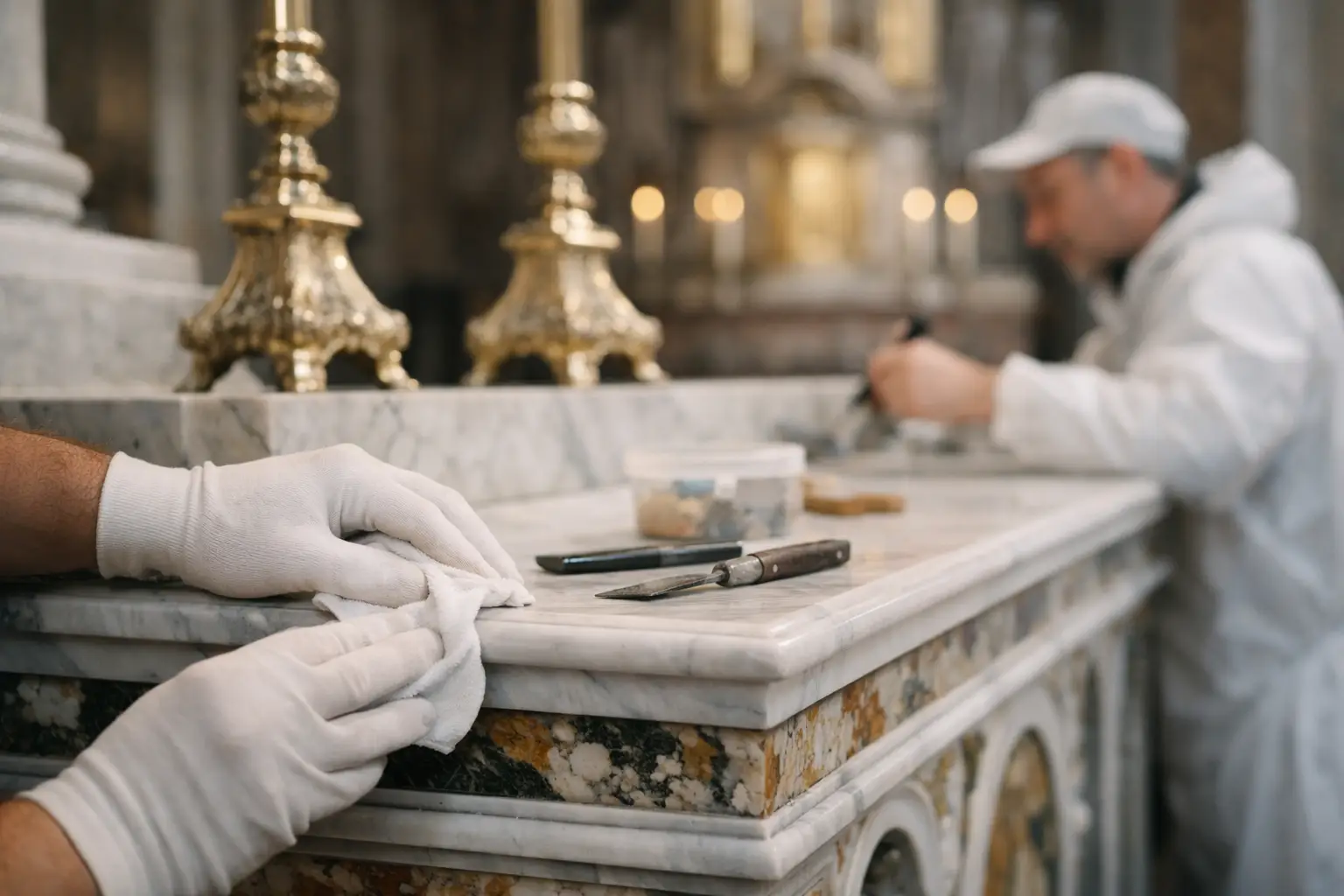
A marble altar is not simply a furnishing within a church. It is the visual and spiritual centre of the sanctuary: a place shaped by liturgy, devotion, craftsmanship and the passing of generations. Church marble altar restoration therefore asks for more than a polished surface. It requires a measured understanding of the stone, its history, its structure and the atmosphere it has carried through time.
Whether the altar is richly inlaid with coloured marbles, carved from a single pale block or composed of several architectural elements, every intervention should preserve its identity. The aim is never to make a historic altar look newly made. It is to recover its legibility, dignity and strength without erasing the marks that belong to its life.
Why a Marble Altar Requires Specialist Restoration
Marble can appear permanent, but it is a living natural material in architectural terms. It responds to moisture, salts, temperature changes, candle soot, cleaning products and structural movement in the church itself. Over decades, these forces may leave a surface dulled by deposits, marked by stains or fractured along veins and joints.
The most visible damage is not always the most serious. A fine crack can indicate a detached element, a failing metal fixing or movement in the supporting masonry. A darkened area may be caused by wax and airborne particles, but it can also point to rising damp or soluble salts migrating through the stone. Treating the visible symptom without identifying its source can lead to a brief improvement followed by further loss.
This is why the restoration of a sacred altar begins with attention rather than machinery. Its decorative language, construction method and condition must be read as carefully as an architectural drawing. In historic interiors, the altar must also be considered in relation to its surrounding reredos, paving, steps, balustrades and light. Marble has a particular way of receiving candlelight and daylight; an insensitive repair can interrupt that harmony at once.
The First Step Is a Careful Survey
Before any cleaning or repair, a detailed condition survey establishes what is original, what has been altered and where the greatest risks lie. This stage typically records cracks, chips, missing inlays, open joints, surface deposits, old repairs and areas of instability. It also identifies the marble varieties used, which may range from Carrara and Verde Alpi to richly figured breccias or rare local stones.
Material identification matters because no two marbles behave in exactly the same way. A treatment that is suitable for a dense, pale marble may be too aggressive for a porous, veined or highly polished stone. The same care applies to adjacent materials. Gilded bronze, stucco, mosaics, painted decoration and timber elements may all be vulnerable to inappropriate moisture or cleaning residues.
A proper survey also distinguishes between patina and deterioration. The gentle softening of a polished surface, minor variations in tone and traces of historic use can be part of an altar's authenticity. By contrast, active salt efflorescence, powdering stone, unstable fragments and wax accumulation require considered action. The difference is essential: conservation respects age, while restoration addresses damage.
Understanding the Causes Before Repairing the Effects
Churches present demanding environmental conditions. Many are intermittently heated, exposed to seasonal humidity and ventilated in ways that have changed little for centuries. Candles, incense and flowers add to the deposits that settle on the altar. In some buildings, water infiltration from roofs, walls or floors creates an ongoing cycle of moisture and salts.
For this reason, the finest repair will not endure if the underlying cause remains untreated. A restoration programme may need to include improvements to drainage, roof maintenance, ventilation or the isolation of damp masonry from the altar structure. These works are less visible than a newly revived marble surface, yet they are often what protects the intervention for the decades ahead.
Cleaning Without Taking Away History
Cleaning is among the most delicate stages of church marble altar restoration. Strong acids, abrasive powders and domestic polishes can etch marble, strip its finish and leave an unnatural brightness. They may also drive contaminants deeper into open pores or damage adjoining materials.
The right method depends on the deposit and the stone. Dry surface dust may require only soft brushes and controlled vacuuming. Soot and greasy residues can call for carefully tested aqueous systems or specialist poultices. Wax drips must be reduced patiently, with close control of heat and solvents where appropriate. Each procedure should be tested first in discreet areas and adjusted according to the response of the material.
The desired result is not a uniform, sterile white. It is a surface whose carvings, veining and colour regain clarity while retaining the visual depth that only time can give. On an altar of polychrome marble, this restraint is especially important. The contrast between stones is part of the original composition, and over-cleaning one element can disturb the balance of the whole.
Repairing Cracks, Losses and Unstable Elements
Once the altar is clean enough to be properly understood, structural repairs can be planned. Open joints, detached mouldings and fractured slabs may require consolidation, precise reassembly and discreet mechanical support. Where historic iron fixings have corroded and expanded, they can place great pressure on the surrounding marble. Their careful replacement may be necessary to prevent further splitting.
Missing sections present a more nuanced question. If a loss disrupts stability, liturgical use or the reading of an important decorative scheme, a replacement may be justified. New stone should be selected for compatibility in colour, texture and physical behaviour, then shaped by hand to follow the existing profile. Yet an exact visual imitation is not always the best answer. In many conservation contexts, a finely integrated repair should remain distinguishable on close inspection, preserving honesty between old material and new work.
Modern fillers and resins can be useful, but they are not universal solutions. Their colour stability, reversibility and long-term behaviour must be assessed against the character of the marble and the size of the repair. A small chip and a major fractured support demand entirely different responses. Good restoration accepts this complexity rather than forcing every problem into one technique.
Recreating Lost Decorative Detail
Where carved ornaments, inlaid motifs or stone veneers have disappeared, the decision to recreate them should be made with care. Surviving fragments, archival photographs and the altar's wider design can provide reliable evidence. Without such evidence, invention risks creating a decorative language that never belonged to the church.
When reconstruction is appropriate, traditional stoneworking becomes central. Profiles must be measured, veining considered and finishes matched so that the new element belongs to the composition without pretending to be original. This work calls for the same disciplined hand that has shaped sacred and civic stonework across Italy for centuries: technical precision in service of beauty.
Respecting Liturgical Life and Heritage Requirements
An altar is often still in use. Restoration planning must therefore respect the church calendar, periods of worship and the practical needs of clergy and congregation. Dust control, access, protection of nearby furnishings and the safe handling of heavy stone all deserve early consideration. In some cases, work is best phased around major feasts or carried out within carefully screened areas.
For listed churches and protected works, dialogue with heritage authorities is equally important. Documentation should record the altar before, during and after treatment, including materials, methods and any discoveries made during dismantling or cleaning. This record becomes part of the monument's future care. It allows later custodians to understand what was done and why.
A specialist workshop brings together the skills this responsibility demands: stone diagnosis, conservation judgement, fabrication, carving and site installation. At Torchio Marmi, a heritage of Italian stonework dating to 1860 informs an approach in which every commission is treated as an individual work, not a standard repair. The material, the sacred setting and the history of the object guide the work from the first survey to the final fitting.
A Restoration That Can Endure
The completion of works should mark the beginning of a maintenance plan, not the end of responsibility. Gentle routine dusting, prompt attention to wax and spills, careful control of flower water, and periodic inspection for damp or movement can prevent minor issues from becoming complex repairs. Harsh cleaning products should remain far from marble, however tempting a quick result may seem.
There is no single formula for preserving a church altar. Some require minimal conservation, while others need structural intervention and the patient recreation of lost stonework. What remains constant is the obligation to work with humility. When marble is restored with knowledge and restraint, the altar continues to hold light, ritual and memory in the same enduring presence for which it was first created.