
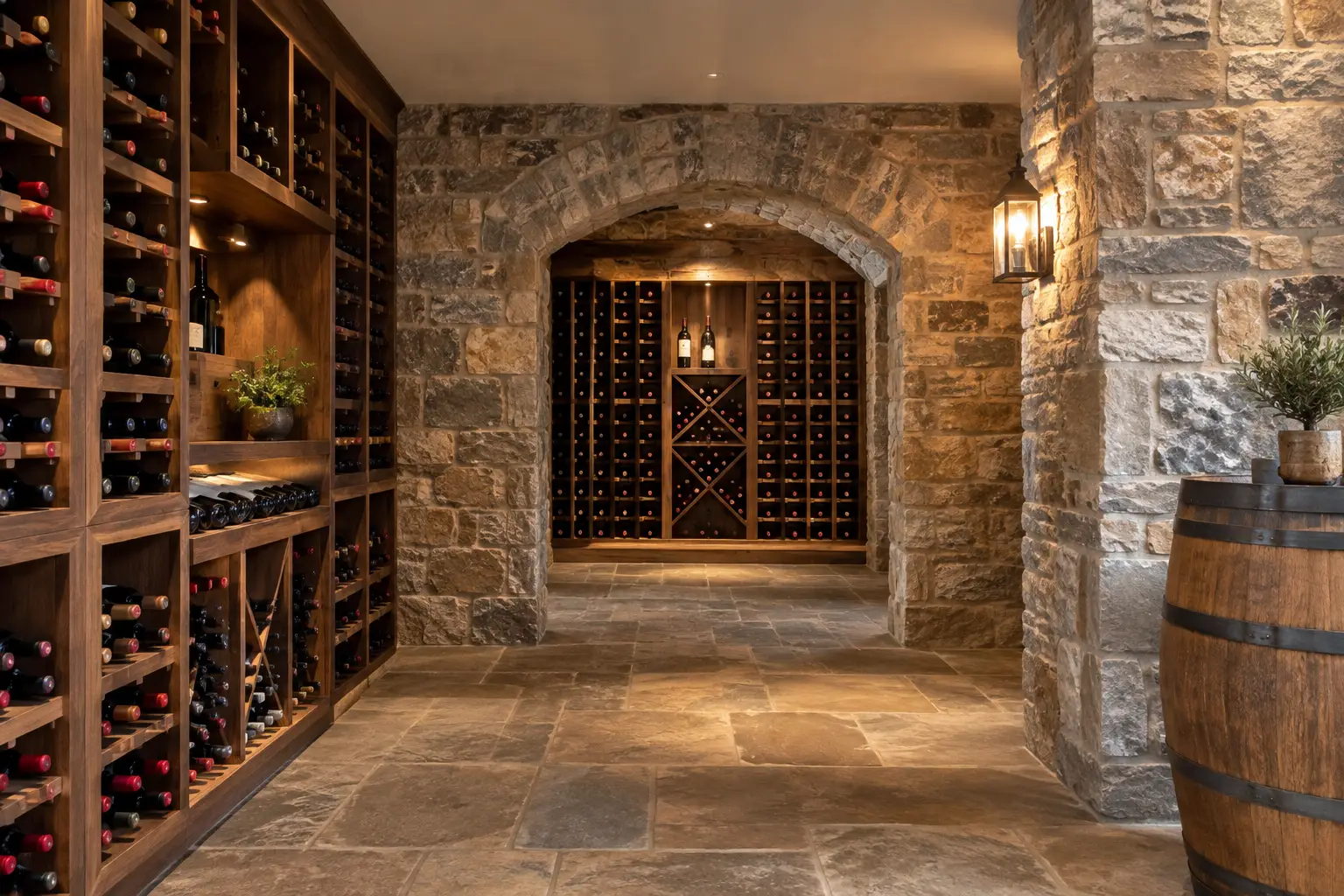
A fine bottle asks for more than a rack and a controlled temperature. It deserves a setting with composure: a room where the materiality feels as considered as the collection itself. Custom wine cellar stonework gives that room its permanence, shaping the atmosphere around wine while answering the practical demands of storage, circulation and maintenance.
Stone has long belonged to the culture of wine. It recalls cool cellars beneath historic houses, vaulted cantine, vineyard estates and the patient passage of time. Yet in a contemporary residence, the effect should never become theatrical. The finest cellar is not a stage set. It is an architectural room in which proportion, light, timber, metal and natural stone are brought into a quiet, convincing harmony.
Why stone belongs in a bespoke wine cellar
A wine cellar is a technical environment, but it should retain a sense of welcome. Depending on the collection, it may be a private reserve, a destination for entertaining or a discreet extension of a dining room. Stone brings visual gravity to each of these possibilities. Its veining, grain and subtle changes in tone cannot be repeated by manufactured surfaces, allowing the room to acquire a distinct identity.
There is also a relationship between natural stone and thermal mass, although it must be understood clearly. Dense stone can help moderate short-term shifts in temperature, particularly when it forms part of a well-designed envelope. It is not, however, a substitute for correct insulation, vapour control, refrigeration and ventilation. A beautiful wall that has been installed without regard for moisture management may suffer from staining, salts or movement over time.
The right commission therefore begins with both atmosphere and performance. Wall linings, flooring, thresholds, plinths, tasting counters and display niches should be considered alongside the cellar's cooling specification, drainage, access routes and existing structure. Craft lies in making these technical requirements disappear into a room of effortless character.
Selecting stone for the room and its ritual
The most suitable material depends on the architecture, the intended use and the degree of maintenance a client wishes to accept. A cellar intended for frequent gatherings needs a different finish from a contemplative archive of rare vintages. The same is true of a bright, glazed wine room adjacent to a kitchen and a subterranean room with limited natural light.
Travertine for warmth and architectural calm
Travertine has an especially natural affinity with wine spaces. Its softened colour, open texture and ancient character can make a newly built room feel established without becoming heavy. Honed travertine is often well suited to walls, floors and integrated benches, where its restrained movement creates continuity across large surfaces.
Its pores require thoughtful treatment. Filling or leaving them open is a design decision as much as a practical one, but sealing should be selected for the particular stone and environment. In a cellar where glasses are poured and bottles are handled, protection against spills matters. A finish that is too glossy, on the other hand, can lose the quiet depth that makes travertine so persuasive.
Marble for distinction and detail
Marble can lend extraordinary refinement to a tasting table, a fireplace surround, a sculpted basin or a carefully framed entrance. Calacatta, Arabescato and other expressive marbles bring a sense of occasion, while more understated varieties can provide a pale, luminous ground for timber joinery and dark glass.
For principal floor areas, marble calls for an honest conversation about use. It can mark and etch if acidic liquids are left on its surface, and a polished finish may be inappropriate where condensation or spills are possible. Honed, brushed or textured finishes often offer greater ease and a more intimate appearance. The patina of a wine cellar may be part of its beauty, but it should be a patina chosen knowingly, not damage mistaken for romance.
Granite and hard stone for demanding surfaces
Where resilience is paramount, granite and other hard natural stones are compelling choices. They can suit floors, worktops and service areas that receive regular use, while their deeper tones can heighten the sense of retreat within a cellar. A flamed, leathered or finely honed surface brings texture underfoot and reduces the formality of a highly polished room.
Dark stone must be planned with lighting in mind. In a modest cellar, too much black or charcoal material can absorb detail and make labels difficult to read. The answer may be a lighter stone on the floor, a pale plaster ceiling or controlled illumination within the bottle displays rather than abandoning the material altogether.
Custom wine cellar stonework begins with proportion
The most memorable cellars are governed by proportion before decoration. A grand slab may be magnificent in a tall vaulted room but overwhelming in a compact space beneath a townhouse. Conversely, a small-format stone floor, laid with narrow joints and a considered border, can make a limited footprint feel deliberate rather than confined.
Stone can establish order in several ways. A continuous floor might lead towards a focal wall of bottles. A framed portal can turn the threshold into a moment of transition. Recessed shelves lined in the same material as the walls can give the collection the appearance of being held within the architecture itself. These gestures need not be numerous. Restraint preserves the authority of the material.
Book-matched slabs are sometimes appropriate, particularly behind a tasting counter or on a feature wall. Their mirrored veining can resemble a large-scale work of art. Yet this is not the only expression of luxury. A quietly selected limestone with minimal variation, cut and finished with exceptional precision, can feel equally rare. The measure is not spectacle but coherence.
Details that decide how the cellar will live
The performance of stonework lies in the details that are rarely noticed once they are correctly resolved. At floor level, falls, joints and transitions must account for cleaning and any risk of condensation. At walls, fixings and backing systems must suit the substrate and the load of the chosen cladding. Around refrigeration units, access for servicing should remain discreet but straightforward.
Lighting deserves equal care. Warm, low-glare illumination reveals texture and makes a collection inviting, but excessive heat or poorly placed fittings can compromise both comfort and presentation. Concealed linear light can trace a stone reveal; a restrained pendant may gather people around a tasting table. The stone should receive light gently, allowing its crystalline detail or fossil marks to emerge gradually.
The meeting of materials is another point of judgement. Oak, walnut, bronzed metal and blackened steel can sit beautifully beside stone, provided their scale is balanced. Timber bottle racks introduce warmth and acoustic softness. Metal can give structure and precision. Stone supplies the lasting presence that prevents the room from feeling like fitted furniture alone.
Craft, fabrication and installation
Natural stone does not tolerate vague decisions. Each slab has direction, variation and physical limits. Before fabrication, the material should be inspected, laid out and assigned to its place in the composition. Veins may be continued across adjoining pieces, or deliberately interrupted to create a quieter rhythm. Edges can be fine and contemporary, softly rounded, hand-finished or shaped to recall historic joinery.
This is where specialist knowledge changes the result. A wine-cellar floor may need a precise anti-slip finish without becoming coarse. A thin stone lining may need reinforcement or a tailored fixing system. A large countertop must be supported in a way that respects both the visual lightness of the design and the weight of the material. These are not decisions to be deferred to site.
At Torchio Marmi, a tradition of Italian stone craftsmanship extending from 1860 informs this work from material selection to installation. The aim is not simply to clad a room, but to give each surface its proper place within an enduring architectural composition.
Designing for a patina worth keeping
A cellar is rarely complete on the day it is installed. Bottles accumulate, familiar labels return, and a table begins to hold the memory of shared evenings. Natural stone responds to this passage of time with nuance. Some materials darken slightly, some soften at their edges, and some reveal small traces of use. Proper sealing and informed care protect the surface, but they need not erase its capacity to grow more beautiful.
For this reason, the most successful choice is often not the rarest stone or the most dramatic slab. It is the one whose character will still feel right after years of use, changing light and evolving collections. Begin with the room you want to inhabit, then allow the stone to give that ritual a lasting home.