
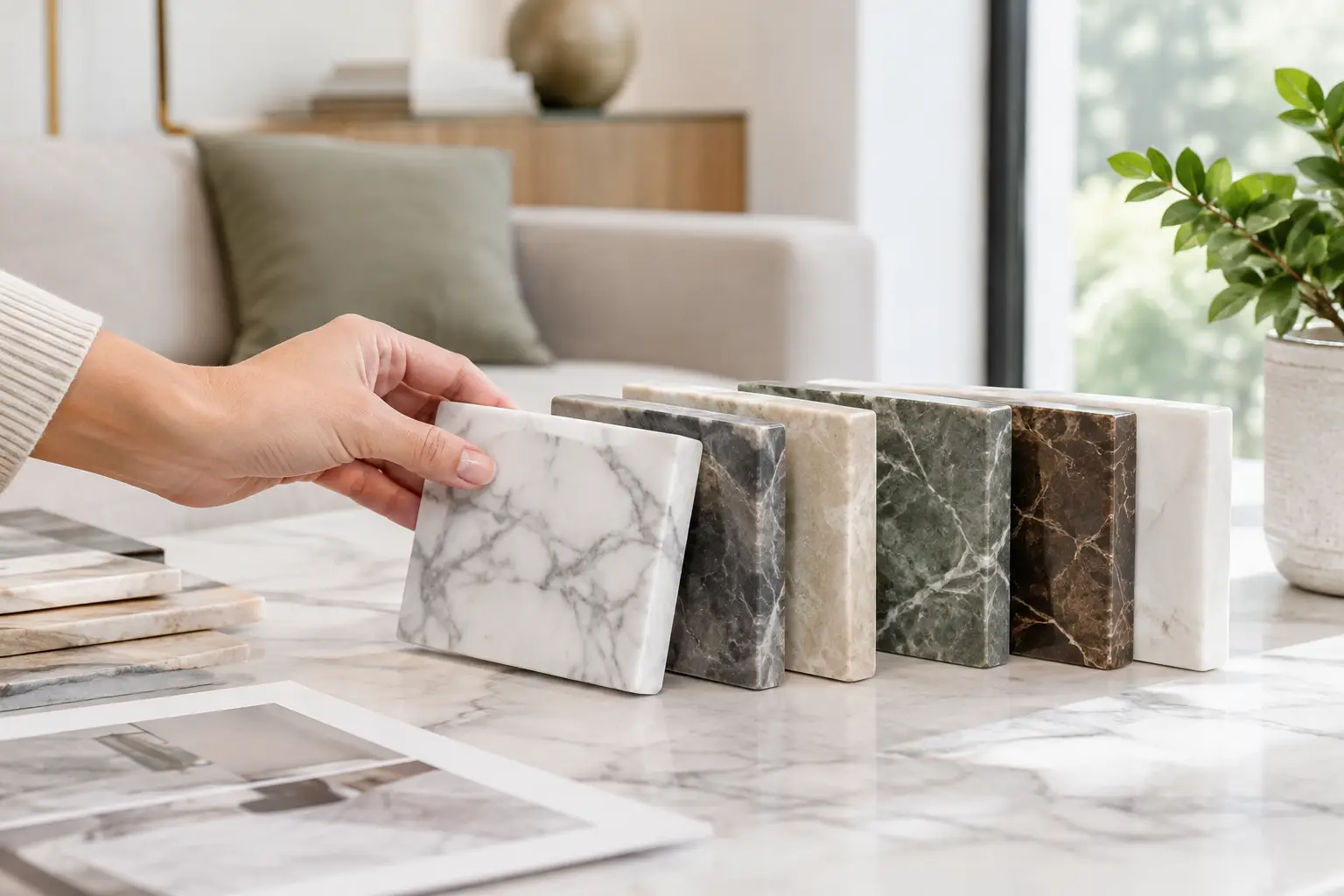
Marble is never simply white, grey or green. It carries movement, depth and geological memory within every slab. Knowing how to choose marble means looking beyond a small sample and understanding how a living natural material will inhabit a room, respond to light and acquire its own quiet character over time.
For a private residence, a hospitality interior or a historic restoration, the right choice begins with the atmosphere you wish to create. Marble can bring composure to a bathroom, ceremony to an entrance hall, warmth to a fireplace surround or a singular presence to a table. Its beauty is enduring, but its success depends on an informed conversation between material, design and use.
Begin with the room, not the slab
A marble chosen for a dramatic reception space may not be the right marble for a heavily used kitchen. Before considering colour or veining, establish the role the stone must perform. Is it a floor exposed to daily footfall, a vanity top in a family bathroom, a wall intended to become an architectural focal point, or a finely detailed piece of furniture?
This practical context guides every later decision. In a hallway, resistance to abrasion and a finish with sufficient grip deserve particular attention. On a wall, where the stone will not meet the same physical demands, visual composition may take precedence. A kitchen worktop calls for an honest acceptance that marble is more sensitive than granite or engineered alternatives: acids, oils and coloured liquids can mark it if left unattended. For some clients, this gentle evolution is part of marble's appeal. For others, a different natural stone is the more considered choice.
Scale matters equally. A compact powder room can welcome a deeply veined, expressive marble that might overwhelm a larger setting. Conversely, a generous floor can carry broad, tranquil fields of pale stone and gain a sense of continuity from carefully planned joints and bookmatched sections.
How to choose marble by colour and veining
Colour establishes the first mood. Pale marbles can make an interior feel luminous and measured, with grey or gold veins providing discreet rhythm. Dark varieties create gravity and contrast, especially when paired with timber, bronze or soft plaster. Green, red and richly coloured stones bring a more decorative, almost painterly quality, often best used where they can be appreciated as a deliberate gesture.
Yet colour alone is an incomplete way to choose. Observe the ground, the density of the veining, the direction in which it travels and the degree of contrast between the two. Some marbles are calm and cloud-like; others are architectural, with linear marks that can elongate a surface; others are dramatic compositions in their own right.
Always view the actual slabs intended for the project. A hand sample indicates the family of stone, but it cannot reveal the full movement, variation or personality of a large block. Natural fissures, tonal shifts and mineral inclusions are not necessarily defects. They are often the evidence of authenticity. What matters is deciding, before fabrication, which features should be celebrated, softened through layout or positioned away from the most visible areas.
For feature walls, fireplace cladding and large bathroom elevations, bookmatching deserves consideration. This technique opens adjoining slabs like the pages of a book, mirroring their veining to form a symmetrical composition. It can be magnificent, but it is not universally appropriate. A quiet interior may call for a continuous, less theatrical layout, while a bold residence may benefit from the visual ceremony of a carefully matched pair.
Choose a finish that suits the way you live
The finish changes both the appearance and performance of marble. A polished finish intensifies colour, reflects light and brings out the depth of the veining. It is particularly beautiful for wall cladding, vanity tops, formal floors and decorative elements where a sense of refinement is desired.
Honed marble has a softer, more matt appearance. Its surface feels understated and contemporary, allowing the stone's natural character to appear without high reflection. It is often preferred for floors and worktops, though it is not immune to staining or etching. A honed surface may make minor marks less visually emphatic, but it still benefits from attentive care.
Brushed, antiqued and textured finishes offer additional possibilities. They can lend tactile warmth to a country house, terrace threshold or heritage-sensitive project. For wet areas and exterior spaces, slip resistance, drainage, frost exposure and the precise finish specification should be assessed as part of the whole construction. Marble belongs to architecture, not just decoration, and its detailing must reflect that responsibility.
Consider performance without asking marble to be something else
Marble is durable, but it is not indestructible. Its calcium-based composition means it can react to acidic substances such as lemon, vinegar, wine and certain cleaning products. Etching is a change in the surface sheen rather than a conventional stain, and on a polished top it may be especially visible.
There is no universal answer to whether marble suits a kitchen. A lightly used, carefully maintained kitchen can carry it beautifully for generations. A busy household where cooking is constant and effortless maintenance is essential may be better served by granite, quartzite or another stone selected for higher resistance. The same judgement applies to bathrooms: marble performs admirably when properly installed and maintained, but standing water, poor ventilation and unsuitable cleaners will diminish any fine material.
Sealing provides useful protection against absorption, but it is not a guarantee against every mark. It should be specified according to the stone, its finish and its intended use, then renewed when required. A specialist fabricator can advise on practical care from the beginning, rather than allowing maintenance to become an afterthought.
Look closely at fabrication and installation
Exceptional marble can be compromised by indifferent workmanship. The thickness of the slabs, edge profiles, reinforcement, substrate preparation, joint alignment and treatment of openings all influence the final result. In a shower room, for example, the falls, waterproofing and junctions are as significant as the marble itself. In a fireplace, thermal conditions and structural tolerances must be understood before a single piece is cut.
Ask how the fabricator will map the slabs. This process determines the orientation of the veins, the placement of joints and the relationship between adjacent surfaces. It is particularly significant for islands, large floors, staircases and cladding, where a coherent layout turns separate pieces into one architectural composition.
Details should be resolved early. Consider whether an edge should be square, softened, stepped or sculpted; whether a basin is integrated or applied; whether skirting is in the same material; and how the marble will meet timber, metal, glass or plaster. These transitions are where bespoke work announces its quality quietly.
Respect provenance and the life of the stone
For discerning clients and design professionals, provenance is part of the material's value. Knowing where a marble originates, how it has been selected and how it will be worked brings confidence as well as meaning. Supply availability also affects design decisions: a rare stone may be perfect for a small, memorable element but impractical for an extensive floor requiring future replacement stock.
It is wise to order sufficient material for the complete project, including carefully considered allowance for cuts, breakages and later repairs where appropriate. A stone's quarry face changes over time, and a matching slab cannot always be assumed. This is particularly relevant for restoration, where continuity with existing historic fabric requires sensitivity, research and material judgement.
Since 1860, Torchio Marmi has approached this judgement as both craft and custodianship: selecting stone not as a standardised finish, but as a material with a history, a technical nature and a place within a larger architectural story.
Let the material retain its voice
The most successful marble interiors do not force uniformity upon a naturally varied stone. They establish enough order in the layout, lighting and detailing for the material to speak with clarity. View slabs in the light closest to the finished setting, consider them beside the intended joinery and metalwork, and give the choice the time it deserves.
A well-chosen marble will not merely complete a scheme. It will gather light, hold memory and become more personal with every year of use - a lasting expression of timeless Italian style.