
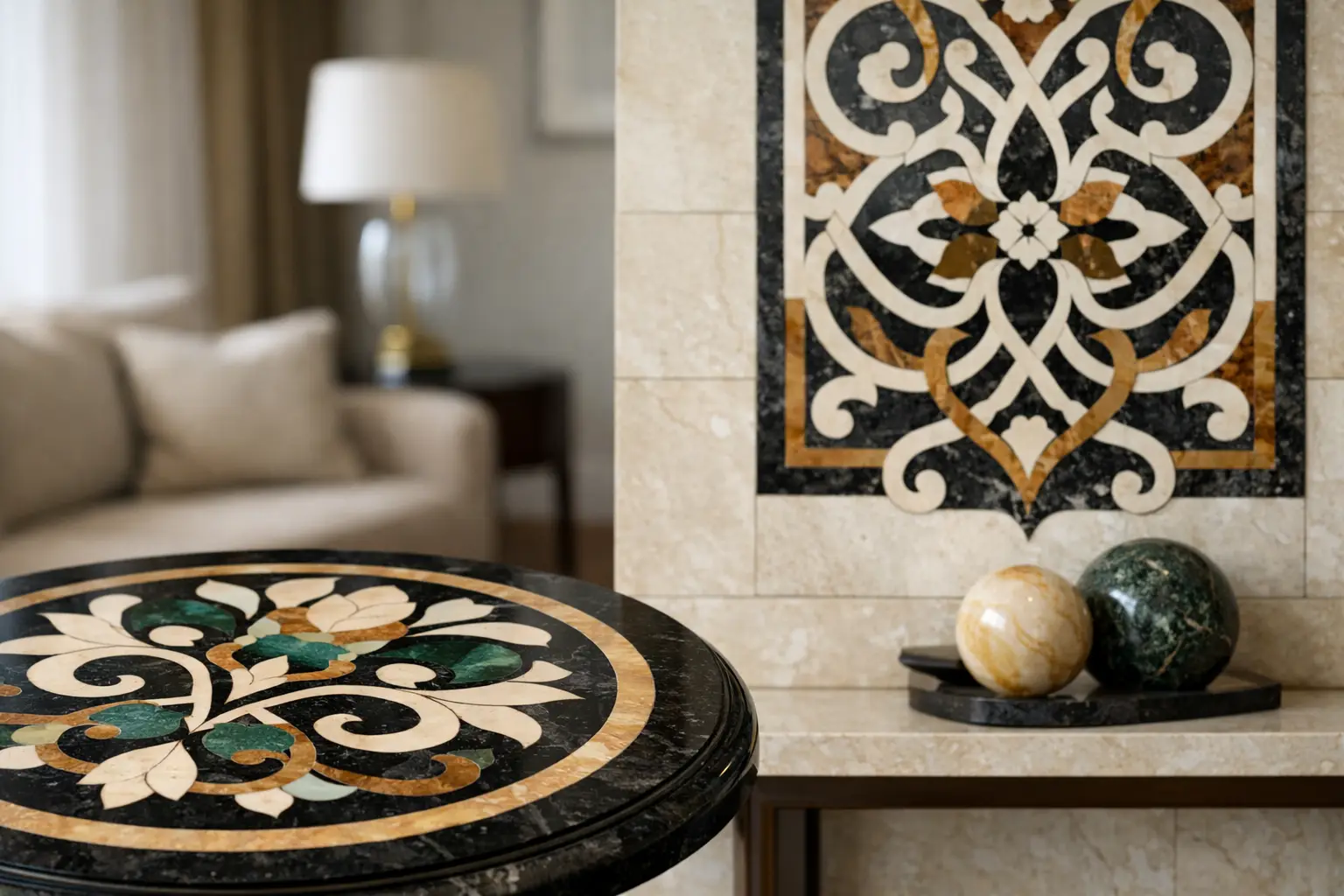
A stone inlay should never feel applied as an afterthought. Whether it is set into a marble entrance floor, a dining table, a fireplace surround or a discreet bathroom detail, its pattern must belong to the architecture. Understanding how to commission stone inlay begins with that principle: the work is not simply a decorative surface, but a meeting of material, proportion, light and skilled handwork.
For a private residence, hotel, sacred space or heritage building, an inlaid composition can establish a sense of arrival, preserve a historic language or introduce a wholly personal signature. The finest results come from giving the artisan clear intent while allowing the natural character of stone to inform the final work.
Begin with the space, not the pattern
An appealing motif seen in a sample book does not automatically suit every room. Before drawings are prepared, consider the architecture around the inlay: the scale of the room, the direction of movement, the existing stonework, the level of natural light and the practical demands of the surface.
A large entrance hall can carry a central medallion, a geometric field or a border with confident contrast. In a more intimate setting, such as a powder room or dressing area, a fine linear detail may have greater presence than an elaborate composition. The pattern should be read at the distance from which it will usually be seen. A floor is experienced while walking across it; a wall panel is seen from across a room; a table top invites close observation.
This first conversation should also establish the purpose of the commission. Is the inlay intended to restore a missing historic feature? To frame a piece of furniture? To carry a family emblem, a monogram or an abstract interpretation of a landscape? These decisions shape the design far more meaningfully than choosing colours alone.
How to commission stone inlay with a clear brief
A good brief is precise without being restrictive. Share plans, elevations, photographs of the site and, where possible, a schedule of adjoining finishes. Architects and interior designers will often provide CAD drawings, but a hand sketch and a thoughtful description can be equally valuable at the earliest stage.
State the finished dimensions, intended location and programme constraints. If the work is to be installed within a floor build-up, the fabricator needs to understand thicknesses, underfloor heating, screed condition, movement joints and the sequence of other trades. For a wall application, substrate, fixing method, panel size and access routes matter from the outset. An inlay that is technically beautiful on paper must also be fabricated, transported and installed safely.
It is useful to provide references for atmosphere rather than asking for a direct copy. A Roman geometric pavement, a nineteenth-century vestibule, a botanical illustration or the quiet symmetry of an Italian palazzo can all guide a bespoke design. The artisan can then translate the reference into an original composition appropriate to the project.
Choose stones for character as well as colour
Stone inlay is often described through colour, yet colour is only one part of the selection. Every material carries its own grain, density, reflectivity and relationship with light. A creamy limestone offers softness and calm; Nero Marquina gives graphic depth; green and red marbles bring movement; onyx can create a luminous, almost atmospheric presence when used with restraint.
The strongest palettes tend to combine contrast with harmony. A pale field and dark outline can make a fine motif legible, while closely related tones create a more subtle, woven effect. Veined stones require particular care. Their movement can enrich a design, but when repeated in small pieces it may compete with the pattern. In other cases, a skilled maker can orient the veins deliberately, allowing them to animate leaves, feathers, waves or radiating forms.
Material choice also depends on use. An entrance floor demands stones suited to foot traffic, cleaning and potential grit carried in from outdoors. A highly polished, pale and porous stone may be entirely suitable for a protected wall panel but less forgiving in a heavily used hall. The finish matters too: honed surfaces offer a quieter, more tactile appearance, while polish heightens colour and reflection. There is no universal right choice, only the right choice for the setting.
Whenever possible, review physical samples under conditions close to those of the finished interior. Daylight, warm artificial lighting and surrounding timber, metal or paint can alter the perceived tone considerably. For significant commissions, viewing the selected slabs before cutting provides another valuable point of control.
Agree the technique and level of detail
The phrase stone inlay encompasses several traditions. Opus sectile uses shaped pieces of stone to create figurative or decorative images. Geometric marquetry relies on precisely cut elements assembled into repeating or radiating patterns. Fine inlay may sit flush within a larger slab, while more architectural compositions are fabricated as full panels or floor fields.
The chosen technique affects cost, lead time and visual effect. A broad geometric border may require a disciplined cutting and assembly process, yet remain relatively economical because its forms repeat. A detailed floral design, crest or pictorial scene involves many individually shaped pieces, close-fitting joints and greater hand-finishing. This is where the value lies: not in ornament for its own sake, but in the patient calibration of every line.
Ask to see a scaled design drawing that shows the overall composition and its relationship to surrounding elements. For complex work, a full-size section, colour rendering or sample panel may be worthwhile. It can reveal whether outlines are too fine to read, whether the palette has sufficient contrast and whether a border aligns convincingly with doorways, furniture or room axes.
Treat fabrication as a dialogue
Once the design is approved, fabrication begins with the selection and cutting of each component. Digital tools can assist with accuracy, especially in architectural geometries, but they do not replace judgement. Stone varies even within a single block, and the maker must decide where a vein should fall, how a fragile detail can be reinforced and which pieces will sit most naturally together.
At this stage, small adjustments may be necessary. A stone originally proposed may no longer be available in the required quantity, or a particularly expressive slab may suggest a better arrangement. Such changes should be discussed openly and documented through updated samples or photographs. Bespoke stonework rewards patience. An early decision made for the sake of speed can be difficult to reverse once cutting has begun.
For heritage commissions, the process may involve an additional layer of research. Existing fragments, archival photographs and the fabric of the building can guide the choice of materials and motifs. The aim is not to make an old surface look falsely new, but to restore continuity with respect for its age, craft and accumulated memory.
Plan installation before the stone leaves the workshop
Installation is where an elegant commission either achieves permanence or encounters avoidable difficulty. Confirm responsibility for site measurement, delivery, lifting, substrate preparation, fixing materials, protection and final sealing. Large or intricate panels may need to be divided for transport, with joints planned to disappear into the pattern. A narrow stair, a lift restriction or a delayed screed can influence fabrication decisions long before installation day.
The substrate must be dry, stable and suitably level. Underfloor heating requires compatible materials and careful allowance for movement. In wet areas, waterproofing and the arrangement of falls are essential. On a floor, joints and thresholds should be resolved as part of the drawing, not improvised on site.
After installation, stone should be protected from subsequent trades. Plaster dust, paint, abrasive debris and unsuitable cleaners can damage a finished surface in a matter of hours. A specialist should also advise on sealing and maintenance, since different stones respond differently to moisture, acids and everyday cleaning products.
Give the commission time to become part of the building
Stone inlay is an investment in material permanence, but it is not static. Light will move across a polished fragment of onyx; a honed marble floor will acquire a gentle patina; the pattern will become familiar to those who cross it each day. These changes are part of its life, not a failure of perfection.
For more than a century and a half, Torchio Marmi has approached such work as an encounter between design, technical knowledge and the enduring language of natural stone. The most memorable commissions leave room for that encounter. Begin with a considered brief, insist on material honesty and allow skilled craftsmanship to give your idea its lasting form.