
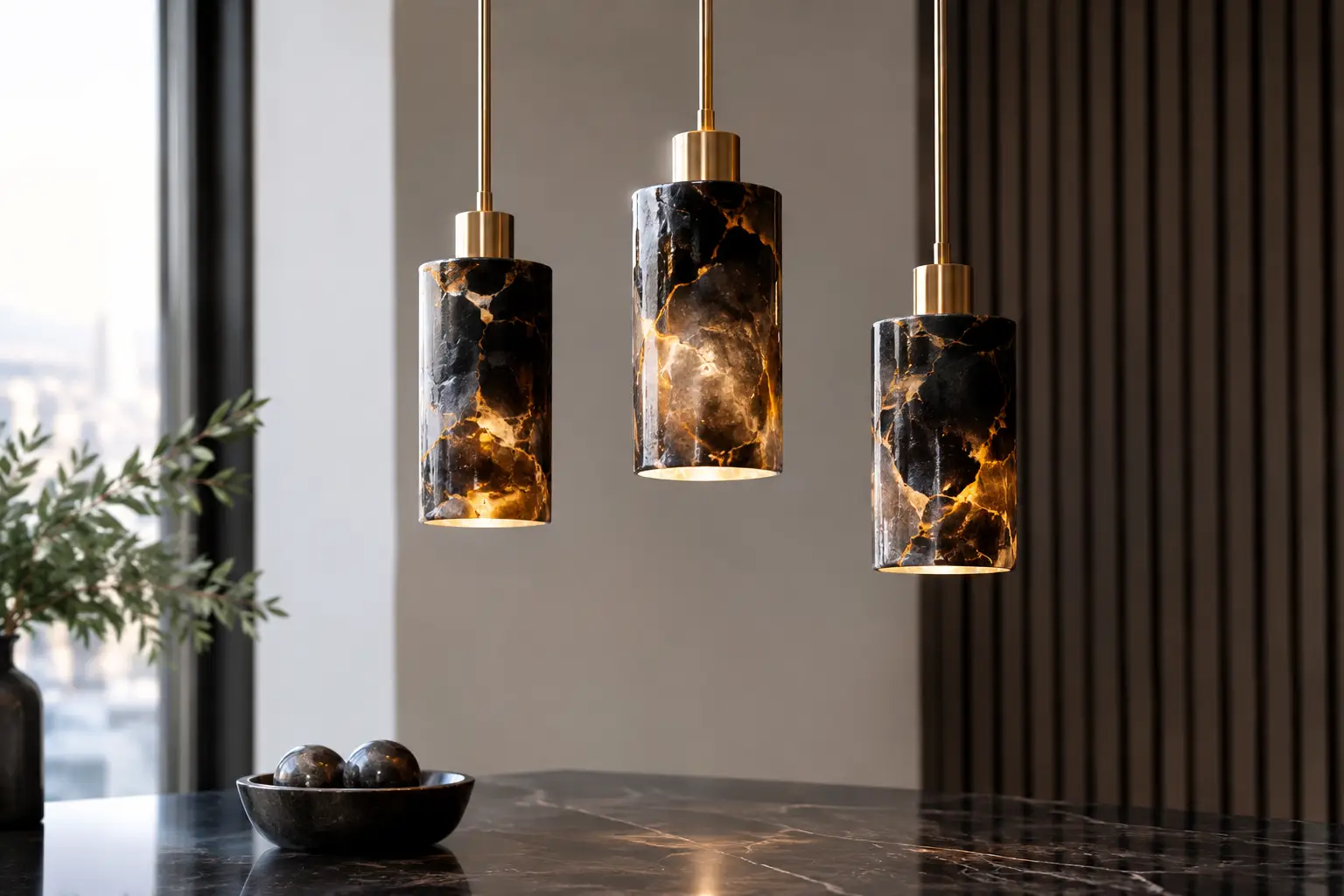
A backlit onyx wall is never merely a light fitting. In daylight, it may appear composed and reserved; once illuminated, its veining acquires depth, warmth and movement. Knowing how to select onyx lighting begins with respecting this changeable character. The aim is not simply to make stone glow, but to give a room an atmosphere that feels considered long after the first impression.
Onyx is a natural material of extraordinary visual range. Some slabs are pale and cloud-like, others carry dramatic rivers of amber, honey, green, rust or black. Light reveals what the stone holds within it, and for that reason the most successful projects begin with the slab itself, rather than with a standardised lighting specification.
Start with the role the illuminated onyx will play
Before selecting a colour temperature or a panel size, establish what the onyx is meant to do in the space. A full-height feature wall in an entrance hall creates a different experience from a softly lit bar front, a bathroom niche, a headboard or a pair of decorative panels framing a fireplace. Scale, viewing distance and surrounding finishes all affect the choice.
For a principal wall, broad and continuous slabs can create a powerful architectural gesture. The book-matched arrangement of two mirrored pieces of onyx may turn natural veining into a focal composition, almost like an abstract fresco. In a more intimate room, a smaller panel can be more persuasive: a quiet source of radiance set among timber, bronze, plaster or dark stone.
Consider, too, whether the feature must illuminate the room or simply contribute to its mood. Onyx lighting is often at its most beautiful as ambient or accent lighting. It can offer a memorable glow, but should not be expected to replace task lighting over a kitchen worktop, beside a mirror or in a study. Layered lighting allows the stone to remain expressive without asking it to perform beyond its intended role.
How to select onyx lighting by choosing the slab first
No two onyx slabs are identical. A photograph, a small sample or a named variety can indicate a direction, but none can reliably predict the effect of a full panel under light. Translucency changes across a single slab, as do veining, mineral density and colour. This individuality is the material's value, not an imperfection to be engineered away.
The selection should therefore take place with actual slabs, ideally viewed both unlit and backlit. Ask to see them at a meaningful scale. A small illuminated sample may appear evenly luminous, while a large panel reveals areas of stronger opacity and unexpected visual drama. In a bespoke interior, these variations should be positioned deliberately rather than treated as surprises on site.
Book-matching deserves particular attention. When two adjoining slabs are cut and opened like the pages of a book, their veining creates symmetry. This can be formal and monumental, especially in reception areas and luxury hospitality interiors. A continuous vein match, by contrast, follows the movement from one slab to the next and often feels calmer. Neither approach is inherently superior. The decision belongs to the architecture, the room's proportions and the desired degree of theatricality.
Thickness is equally significant. Onyx is usually fabricated thinner for backlighting than for conventional cladding, so that light can travel through the material. Yet a thinner section can bring a brighter effect while demanding careful technical support. The final thickness must be determined in relation to the selected stone, its structural qualities, the panel dimensions and the chosen installation system.
Match the light to the stone's natural colour
The same slab can look serene, golden or overly harsh depending on the light behind it. Colour temperature should complement the dominant tones within the onyx and the palette of the wider interior.
Warm white light generally enhances honey, cream, tobacco and amber varieties, lending them a welcoming, candlelit depth. It is often well suited to private residences, dining rooms, suites and hospitality settings where comfort matters as much as visual impact. Neutral white may give pale whites, greys and green-toned onyx a clearer, more contemporary presence. Cooler light can occasionally suit a deliberately crisp scheme, but it may flatten warm minerals or make them appear less inviting.
The quality of the light matters as much as its temperature. A high colour rendering index helps preserve the subtleties of the stone, allowing warm veins, crystalline areas and darker inclusions to remain believable. Poor-quality illumination can make a remarkable slab appear dull, greenish or unnaturally uniform.
Dimming is strongly recommended. A luminous onyx panel that is perfect at evening reception level may feel too bright late at night. Dimming allows the installation to follow the rhythm of the room, from quiet morning light to an evening setting for entertaining. In projects with sophisticated controls, programmed scenes can coordinate the stone with ceiling lights, wall lamps and exterior views.
Design the backlighting system, not just the visible surface
The stone is the visible work of art, but the concealed construction determines whether it will appear luminous and even. Uneven lighting, visible points of light or dark bands behind a panel will distract from the material and diminish its natural elegance.
For this reason, onyx lighting should be designed as an integrated assembly. A suitable LED system, diffusion layer, reflective backing, ventilated cavity, supporting frame and access strategy must work together. The distance between the light source and the stone is critical: too little depth can reveal individual LEDs; too much can reduce intensity or make the construction unnecessarily deep. The correct solution depends on the translucency and thickness of the chosen slabs.
Heat management cannot be overlooked. Although LEDs produce far less heat than earlier technologies, enclosed systems still require proper specification and ventilation. Stone, adhesives, electrical components and finishes must be selected as a coherent whole. This is especially important in joinery, humid rooms and spaces where the installation will operate for long periods.
Plan maintenance before the panel is closed. Drivers and control gear eventually require inspection or replacement. A beautiful wall should not need to be dismantled to reach a small electrical component. Discreet access panels, removable sections or serviceable joinery can protect both the installation and the investment.
Give edges, joints and surroundings equal care
Illuminated onyx is unforgiving of casual detailing. A poorly resolved edge can interrupt the illusion of light emerging from stone; a wide or inconsistent joint can pull attention away from the veining. Whether panels are framed in metal, set within timber, finished with a shadow gap or carried into an adjacent stone surface, the detail should feel intentional at close range.
The surrounding materials should provide contrast without competing for attention. Darkened bronze can give pale onyx definition and depth. Walnut or oak may temper a dramatic amber slab with warmth. Honed marble, textured plaster and restrained fabrics often create a quieter setting in which the illuminated stone can hold the room. Highly patterned finishes beside highly veined onyx require greater caution. When every surface speaks at once, none is heard clearly.
In bathrooms, kitchens and wellness areas, technical conditions become more demanding. Moisture protection, suitable electrical ratings, secure fixing and appropriate sealing must be resolved for the precise location. Onyx can be used magnificently in these settings, but it is not a generic decorative panel. It requires material knowledge, accurate fabrication and installation discipline.
Insist on a full-scale review before fabrication
A well-prepared visualisation is valuable, but it cannot replace a physical mock-up. Before final approval, review the selected slabs under the proposed illumination, preferably at close to their finished scale. Observe them during the day and after dark. Check the intensity at several dimming levels, inspect joints and borders, and stand at the distances from which the feature will normally be seen.
This stage often clarifies decisions that drawings alone cannot answer. A vein may be better turned horizontally; a warmer lamp may bring out hidden gold; a stronger diffuser may soften a dense area of stone. Such adjustments are most economical and most satisfying before cutting and installation begin.
For heritage interiors, the review should also consider reversibility and the relationship with existing fabric. A new luminous element must honour the building rather than overwhelm it. In contemporary architecture, the same principle applies in another form: the panel should belong to the spatial composition, not read as an afterthought fixed to it.
A bespoke onyx installation asks for patience at the beginning because it rewards attention for decades. When the slab, light, craftsmanship and setting are considered together, illumination does not sit behind the stone. It seems to arise from its own mineral memory, giving the interior a presence that is both intimate and enduring.