
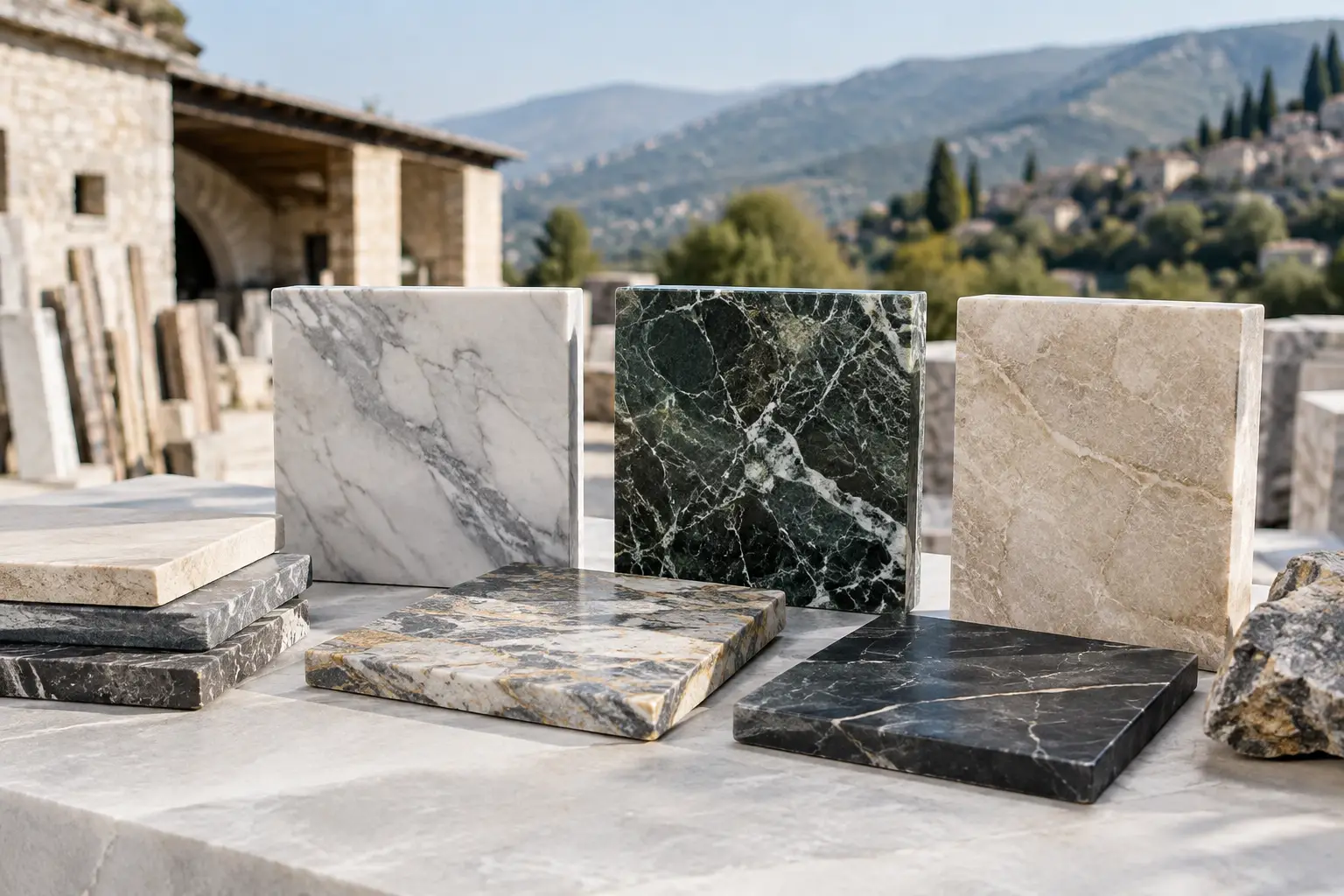
A slab of Calacatta chosen under the cool light of a warehouse can appear entirely different once it meets the southern sun of a terrace, the warmth of walnut joinery, or the soft illumination of a private bathroom. That is why an Italian stone sourcing guide must begin not with a catalogue, but with the place the stone is intended to inhabit. Natural material is never merely selected. It is read, interpreted and composed.
For a residence, hotel, sacred space or restoration project, Italian stone carries more than visual distinction. It brings geological character, regional history and the hand of the artisan into the architecture. Sourcing it well requires a clear conversation between design ambition, technical performance and the singular nature of each block.
Begin with the architectural intention
The first question is not simply whether the project calls for marble, granite, travertine or onyx. It is what the finished surface must express. A quiet, continuous floor asks for a different stone from a fireplace intended as the centrepiece of a room. A historic façade has different demands from a contemporary kitchen island, even where the desired palette may appear similar.
Consider the scale of the space, its natural and artificial light, and the materials that will sit alongside the stone. Fine-veined white marble can bring luminosity to a restrained interior, while a richly marked Arabescato or Breccia may deserve generous, uninterrupted panels where its movement can be appreciated. Travertine offers an architectural calm that works beautifully in large-format flooring and wall cladding. Onyx, often backlit, becomes closer to an illuminated work of art than a conventional surface.
This early stage also determines the appropriate finish. A polished surface heightens depth and reflection, but may be less suitable for wet areas or busy entrances. Honed stone has a softer, more contemporary presence. Brushed, bush-hammered and sandblasted finishes provide texture and improved grip, particularly outdoors. The same material can take on a markedly different character through its finish alone.
Know the origin, not just the name
Italian quarry names are often used broadly in design conversations, yet provenance matters. Two slabs sold under a familiar commercial name may differ considerably in ground colour, veining, density and working qualities. A responsible selection process identifies the quarry or extraction area, the current availability of the material and the variation that should be expected from the specific block.
Carrara marble, for example, encompasses a family of materials rather than one uniform appearance. Statuario, Calacatta and Arabescato each have recognisable traits, but every extraction has its own composition. The same is true of travertine from Lazio, granite from Sardinia, and stones sourced from smaller Italian quarries whose limited production is part of their appeal.
For projects requiring continuity across multiple rooms, elevations or phases of construction, block selection becomes especially significant. Matching is never a matter of ordering a colour from a sample board. It depends on reserving sufficient material from compatible production, then planning how individual slabs will be allocated. A stone specialist should be able to explain what is known, what remains variable and how that variation will be used to advantage.
Request slabs, not promises
A small sample is useful for establishing direction, but it cannot represent the full visual rhythm of a natural stone. Before final approval, inspect the actual slabs wherever possible. View them both vertically and horizontally, under daylight and under the intended artificial lighting. Look beyond the most dramatic vein: assess the background tone, areas of natural filling, open pores, mineral inclusions and the relationship between slabs.
This is particularly important for book-matched surfaces, where adjacent slabs are opened like pages to create a mirrored pattern. The result can be magnificent on a bathroom wall, reception desk or feature fireplace, but it demands careful slab sequencing and a fabrication drawing that respects the material's natural direction.
Match the stone to its service conditions
Beauty and suitability must remain inseparable. Marble is an enduring choice for interiors, yet it is calcite-based and can react to acidic substances. In a family kitchen, this may be accepted as part of a surface that gains a gentle patina with use. For a client seeking a more forgiving worktop, certain granites, quartzites or technically appropriate stones may be the wiser choice. The decision depends on how the room will truly be lived in, not how it will be photographed.
Exterior applications require equal discipline. Frost resistance, water absorption, slip performance, thermal movement and exposure to pollution must all be assessed. A pale stone façade may be visually ideal, but its fixing system, joint design and surface finish need to respond to the building's orientation and local climate. Pool surrounds need tactile, slip-conscious finishes and materials that tolerate moisture and chemical exposure.
In heritage work, compatibility is paramount. Replacing damaged historic stone with a visually similar but physically incompatible material can accelerate deterioration in the surrounding fabric. Porosity, salt behaviour, compressive strength and weathering patterns all deserve investigation. Restoration is an act of care for a building's memory, not an opportunity for approximation.
Allow for nature's variation
Natural veining, fossils, pinholes and tonal shifts are not manufacturing flaws. They are the material's identity. However, authenticity does not mean leaving the outcome to chance. The role of experienced sourcing and fabrication is to make variation intentional.
A good stone schedule defines where visual movement is welcome and where calm is essential. It may reserve the most expressive slabs for a principal wall, use quieter pieces for secondary areas, and position veins to draw the eye towards a fireplace, doorway or sculptural basin. Where a project needs a uniform field, the selection may favour stones with a more consistent structure, while still retaining the depth that distinguishes natural material from an imitation.
Clients and designers should also discuss acceptable treatments openly. Some stones are naturally filled to close pores or stabilise small cavities. Resin reinforcement may be appropriate for selected fragile materials. These techniques can support performance and fabrication, but they should be understood as part of the material specification rather than discovered after installation.
Plan fabrication while the stone is being sourced
Sourcing and fabrication are often treated as separate decisions. For bespoke work, they are one continuous process. The thickness of the slab, the weight of the finished element, the required edge profile, the position of cut-outs and the transport route all influence which material can be used and how it should be prepared.
A dramatic monolithic island, for instance, may require carefully engineered joins, concealed support or a lighter construction than its appearance suggests. A vein that looks compelling across a slab may become structurally vulnerable if a hob cut-out or basin opening is placed in the wrong location. Large wall panels call for precise survey work, suitable backing and a fixing strategy designed for their dimensions and weight.
This is where workshop knowledge protects the original design idea. Digital templating and cutting technologies bring accuracy, but they do not replace judgement. The craft lies in orienting the stone, refining edges by hand, resolving corners and ensuring that the finished work feels inevitable in its setting.
Establish a realistic programme
Exceptional stone cannot always be obtained to an arbitrary timetable. Quarry production, block availability, slab transport, approvals and fabrication all require time. Rare materials may need a longer lead period, particularly where a project needs substantial quantities from one compatible selection.
Early engagement gives the design team more freedom. It allows alternatives to be considered before a specification becomes fixed, enables slabs to be reserved, and creates time for full-size mock-ups where the project warrants them. It also reduces the costly compromise of substituting a stone after surrounding finishes have been chosen.
Assess the supplier as carefully as the material
The right partner offers more than access to a yard. They provide traceability, technical advice, careful selection and responsibility from the first sample through to installation. Ask how slabs are checked, how variation is documented, whether the workshop will produce layout drawings, and who carries responsibility for measuring, delivery and fitting.
For projects abroad, packaging, insurance, customs documentation and installation coordination become part of the stone specification. A supplier with experience of complete commissions can anticipate these practical requirements without diminishing the architectural ambition of the work.
Torchio Marmi approaches this process through material knowledge developed across generations: from bespoke interiors and architectural surfaces to the precise demands of restoration and monuments to memory. That breadth matters because it connects visual judgement with the realities of permanence.
The finest Italian stone is not chosen because it is rare, pale, highly polished or instantly recognisable. It is chosen because its origin, character and technical qualities belong to a particular design. When selection is made with patience, the finished surface does more than complete a room or building. It gathers light, bears time with grace, and becomes part of the story those spaces are made to hold.