
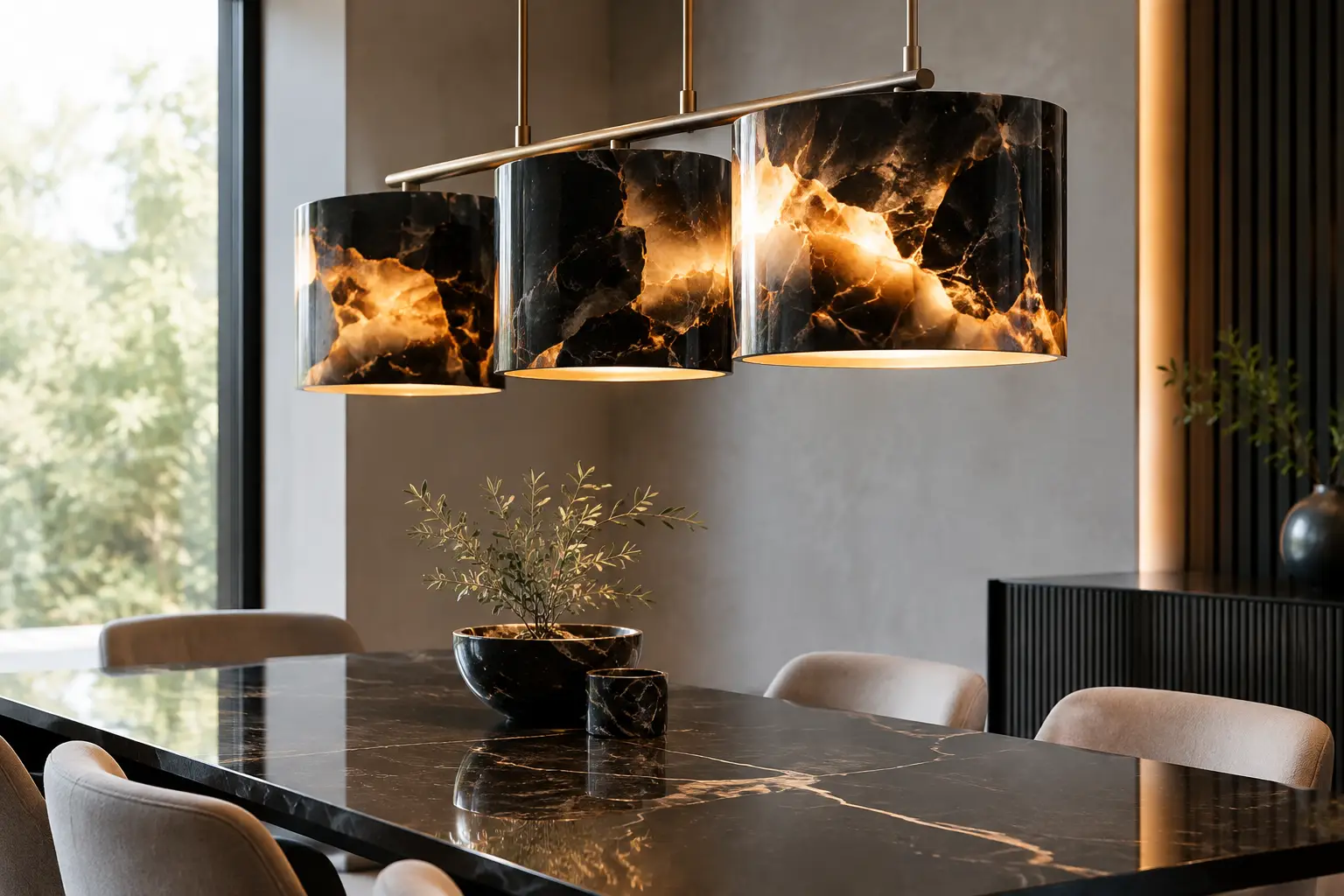
A wall of onyx does not merely reflect light. It seems to retain it, allowing veins, clouds and mineral variations formed over millennia to emerge from within. This is the singular appeal of onyx lighting: stone becomes atmosphere, and illumination becomes part of the architecture rather than an addition to it.
For a private residence, a hospitality interior or a distinguished commercial space, backlit onyx can create a moment of stillness and theatre. Yet its beauty depends on disciplined material selection and precise fabrication. The most memorable installations are never accidental. They are composed around the character of a particular slab, the quality of its light and the experience of the room.
Why onyx responds so beautifully to light
Unlike most natural stones, onyx possesses a remarkable translucency. Light can pass through its crystalline structure, revealing a depth that remains hidden under ordinary surface lighting. Honey golds, ivory, pale green, smoky grey, rust and deep amber take on new life as the slab is illuminated from behind.
This quality makes every application individual. A polished surface may appear restrained in daylight, then become luminous after dusk. Veining that first reads as delicate can become graphic and almost architectural when lit. In a large book-matched composition, the stone’s natural movement can suggest a landscape, a flame or the soft folds of fabric.
That variation is precisely why onyx should not be approached as a uniform finish. Samples are useful for understanding colour families, but they cannot communicate the full visual rhythm of a complete slab. For a significant feature, selection should be made slab by slab, considering not only the face of the stone but also its thickness, density and response to illumination.
Onyx lighting as an architectural material
The strongest projects give onyx a clear role in the interior. It may form a luminous bar front, a fireplace surround, a wall behind a reception desk, a bathroom panel or a framed artwork in stone. In each case, it should belong to the wider language of the space: the joinery, metals, plasterwork, furnishings and natural light around it.
A backlit onyx wall is often most effective when it is allowed to breathe. A broad, calm field can have greater authority than a collection of small decorative inserts. Conversely, a smaller panel can become a jewel-like focal point within a darker material palette of timber, bronze, burnished steel or veined marble.
Scale matters. In a high-ceilinged entrance hall, generous panels and carefully controlled joints preserve the sense of continuity. In a dressing room or powder room, a single illuminated surface may create intimacy without overwhelming the room. The question is not simply where light can be placed, but where the stone can hold attention without competing with everything else.
Book-matching and the art of composition
Onyx is especially suited to book-matching, in which adjoining slabs are opened like the pages of a book so that their veining mirrors across a central line. When executed with care, this can turn a natural geological pattern into a balanced composition of exceptional presence.
Book-matching is not automatically the right answer. Some slabs have a directional movement that is more compelling when continued across a wall rather than mirrored. Others are best presented as a single uninterrupted field. The decision depends on the stone’s own drawing, the dimensions of the surface and the visual axis from which it will be viewed.
A skilled stoneworker considers where cuts should fall, how veins will meet at corners and whether the most expressive areas of the slab should sit at eye level. Such choices distinguish a fitted surface from a work of material design.
The technical discipline behind illuminated stone
The poetry of onyx lighting rests on exacting construction. Light must be evenly distributed across the back of the stone. If the source is too close, individual points or bands may become visible; if it is too weak, the stone can appear dull and opaque. A purpose-designed illuminated cavity, correctly calculated for the chosen panel, allows the material to glow with consistency.
LED technology is generally preferred because it produces little heat, offers long service life and can be carefully controlled. Even so, the specification must take account of ventilation, access for maintenance and the performance of every component behind the stone. Electrical elements should remain serviceable without dismantling the entire installation.
The colour temperature deserves equal attention. Warm white light usually honours the richness of honey, cream and amber onyx, lending rooms a composed and welcoming character. Cooler light may suit certain pale or grey stones, but it can also flatten warmer tones or make them feel less natural. Dimming is often valuable, particularly in residential settings and hospitality spaces, where the desired atmosphere changes from day to evening.
Panel thickness is another essential consideration. Thinner stone permits more light through, but it requires appropriate reinforcement and careful handling. Thicker material carries a different physical presence and may deepen the colour, while reducing luminosity. There is no universal measurement: the appropriate balance is established through tests with the selected stone and the intended lighting system.
Where illuminated onyx belongs
Onyx rewards placement in spaces where people pause. It is less about general illumination than about creating an encounter. Behind a bar, it introduces warmth and ceremony. At a reception desk, it gives arrival a memorable focal point. In a dining room, it can provide the soft visual glow that encourages guests to linger.
In bathrooms, onyx lighting can be particularly evocative when used behind a vanity wall, within a niche or as a feature around a freestanding bath. Here, however, the design must respect the realities of moisture, ventilation and suitable detailing. Natural stone is enduring, but every setting makes different demands of it.
For private homes, an illuminated panel may be most powerful in an otherwise quiet space: an entrance, library, wine room or stair landing. It gives the interior a sense of occasion without relying on ornament. For hotels, restaurants and luxury retail environments, it can become part of a recognisable identity, particularly when paired with bespoke furniture and carefully chosen metalwork.
Choosing the right onyx for the project
There is no single onyx appearance. Some varieties are almost cloud-like, with delicate cream and white translucency. Others contain dramatic bands of gold, brown, green or red. A richly veined slab can become a centrepiece, while a gentler material may be better suited to a room that already contains strong patterns elsewhere.
Consider the stone in its actual setting, not in isolation. Daylight, surrounding finishes and the direction of view all alter its effect. A golden onyx may appear sumptuous beside dark walnut and aged brass, while a pale variety can lend serenity to limestone, plaster and light oak. The intended mood should lead the material decision.
It is also wise to acknowledge the trade-off between spectacle and restraint. Onyx is inherently expressive. In a compact interior, one finely detailed illuminated element may achieve more than multiple glowing surfaces. In a public venue, a larger intervention may be entirely appropriate, provided the lighting is calm rather than excessive.
Care, permanence and informed craftsmanship
Onyx is a natural material and should be treated accordingly. It is softer and more sensitive than granite, and its surface benefits from considered use, suitable sealing and non-abrasive cleaning. In high-contact areas such as bar tops, the design may call for protective measures or for onyx to be positioned as a vertical feature rather than a working surface.
The visual result also depends on fabrication tolerances that are invisible once the project is complete: reinforced panels, discreet joints, carefully finished edges and reliable support systems. These are not secondary details. They protect the stone and preserve the clarity of the design over time.
For more than a century and a half, Torchio Marmi has worked with natural materials as both technical matter and cultural expression. That perspective is especially valuable with onyx, where the hand of the maker must support the voice of the stone without silencing it.
The right illuminated onyx surface does not need to announce itself loudly. It changes the character of a room gradually, from morning light to evening glow, offering a lasting reminder that the most extraordinary interiors are built not only from finishes, but from materials with memory.