
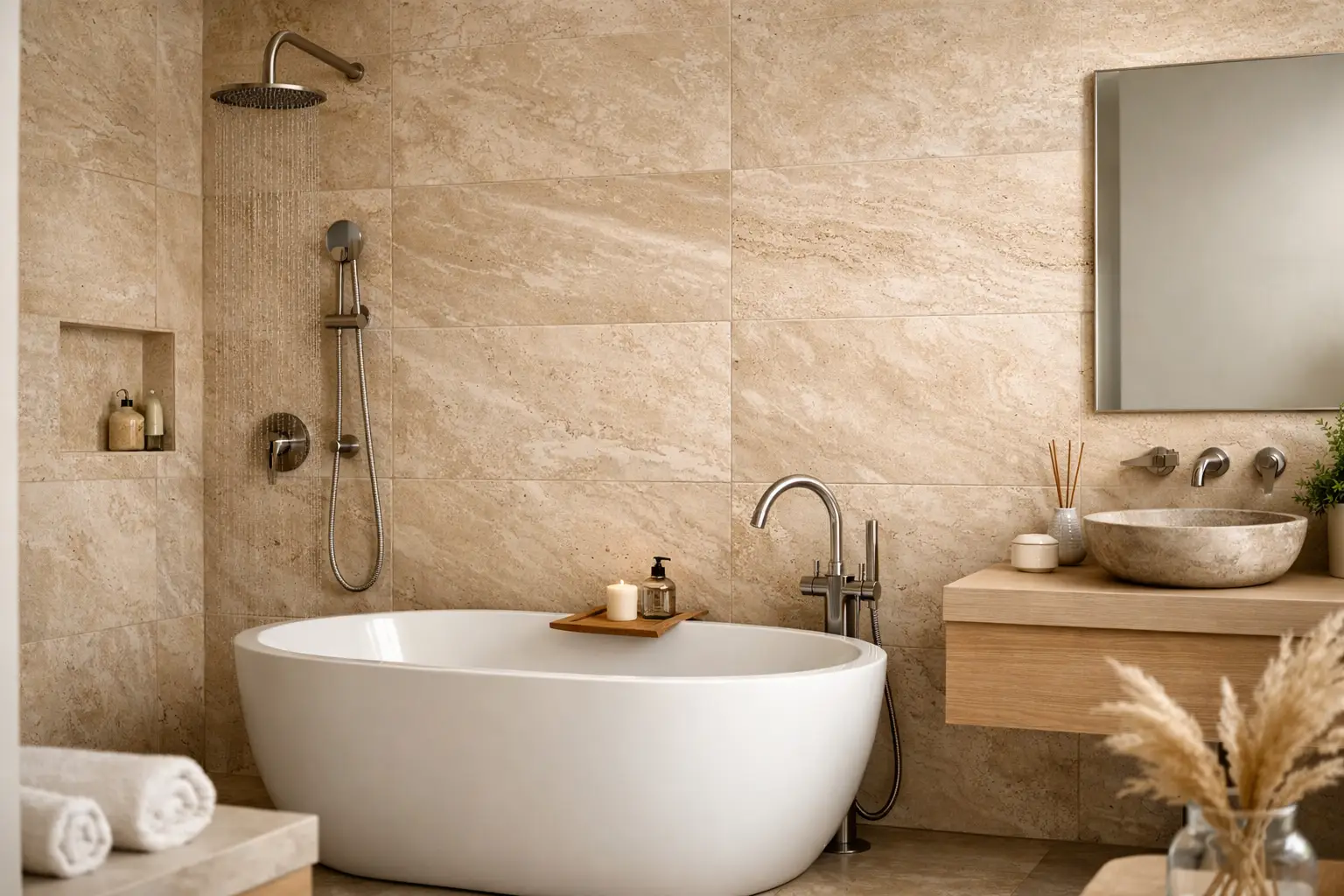
A bathroom has few places to hide. Under changing daylight, candlelight and the clear, direct light of a mirror, every surface declares its quality. Travertine bathroom wall cladding answers that scrutiny with a quiet complexity: mineral veining, open pores, gentle shifts in tone and a warmth that manufactured finishes rarely reproduce. It can make a contemporary room feel grounded, or give a period interior the sense that its materials belong to a longer story.
Travertine is not chosen simply to cover a wall. It is chosen to establish atmosphere. The right slab, carefully cut and composed, turns a bathing space into an architectural interior rather than a collection of fittings. That result depends on decisions made well before installation: selecting the block, considering the room’s light, defining the finish and respecting the technical demands of water.
Why travertine belongs in the bathroom
Formed by mineral-rich spring water, travertine carries the evidence of its origin in its characteristic voids and layered movement. Its palette is naturally restrained, ranging from ivory and pale cream to walnut, silver-grey and warmer golden tones. This makes it particularly suited to bathrooms where calm is the ambition, yet calm must never become anonymous.
Unlike a uniform porcelain surface, each travertine installation has its own identity. A large-format wall can read almost like a landscape, with linear strata travelling across the room; smaller cuts can introduce rhythm and a more traditional architectural scale. Neither approach is inherently superior. The decision rests on proportion, ceiling height, the placement of joinery and whether the room calls for an uninterrupted composition or a more articulated one.
There is also a physical quality to natural stone that photographs cannot fully communicate. Travertine has visual softness without being fragile in character. Beside brushed brass, dark timber, patinated metal or finely detailed oak, it creates a material conversation that feels considered rather than decorated.
Travertine bathroom wall cladding: design begins with the cut
The most consequential aesthetic choice is often the direction in which the stone is cut. Vein-cut travertine follows the bedding of the stone, revealing long, horizontal or vertical bands. It brings definition and movement, especially effective on a principal wall behind a freestanding bath or at a vanity elevation.
Cross-cut travertine is cut across these layers, producing a softer, cloud-like pattern. It is often preferred where a room needs visual stillness, or where the stone must sit harmoniously alongside expressive timber grain, figured marble or sculptural fittings. The material remains unmistakably natural, but its movement is more diffuse.
Slab selection should never be treated as a remote administrative step. For a bespoke project, viewing and allocating the slabs is part of the design process. Tonal variation, pore distribution and veining need to be assessed across the full proposed layout, not in isolation from a small sample. At Torchio Marmi, this attention to the character of each piece is integral to transforming stone from a raw material into a composed surface.
Large slabs or modular tiles?
Large slabs create fewer joints and give travertine greater visual continuity. They are especially persuasive in generous bathrooms, shower surrounds and feature walls where the eye can travel across the stone uninterrupted. Their scale also permits careful vein matching from one panel to the next.
Modular tiles offer a different language. They can suit heritage settings, smaller rooms and schemes that seek a more tactile, crafted rhythm. They may also make handling and future localised repair more straightforward. However, extra joints bring more grout lines and require precise setting-out. A good layout avoids narrow cuts at corners, around niches and beside door openings, where even beautiful stone can appear compromised.
Choosing a finish for light, touch and use
A honed finish is usually the natural choice for bathroom walls. Its satin surface softens reflected light and allows the stone’s depth to remain visible without the sharp glare of a high polish. It has a composed, contemporary elegance and sits comfortably in both classic and modern interiors.
Filled and honed travertine has many of its natural pores filled to create a smoother, more easily maintained face. This is often appropriate for walls in a family bathroom or shower enclosure, where a more even surface is desirable. Unfilled travertine preserves the expressive cavities that give the stone its distinctive character, but asks for greater care and more considered sealing. In a dry powder room, that texture can be captivating. Within a heavily used shower, it may not be the most practical choice.
A brushed finish adds a gently worn tactile quality and can be particularly beautiful in homes where the bathroom is conceived as a retreat rather than a glossy showpiece. The correct finish is not a matter of fashion. It should respond to the room’s light, expected use and the desired relationship between stone, water and touch.
Water is not the enemy, but detail matters
Travertine has been used in architecture for centuries, yet its natural porosity means bathroom installation demands technical discipline. The stone must be appropriately sealed, and the substrate, adhesive, waterproofing system and joint treatment must be specified for the particular application. Surface beauty cannot compensate for inadequate preparation behind the cladding.
In shower areas, waterproofing belongs beneath the stone rather than relying on sealant alone. Falls, drainage positions, junctions with shower trays or floors, recessed niches and penetrations for valves must be resolved before fabrication begins. The most refined result is often the one in which these practical necessities are barely noticed.
Sealants reduce absorption and make routine cleaning easier, but they do not make natural stone maintenance-free. They should be selected to preserve the intended appearance, as some products can alter colour or sheen. Reapplication intervals depend on the finish, the stone’s density and how the room is used. A guest en suite and a busy family shower do not place the same demands on a surface.
Grout deserves equal attention. A joint colour too bright can fragment the wall; one too dark can make pale travertine appear grid-like. Fine joints, carefully matched in tone, allow the stone to remain the principal visual element. Silicone at movement joints should be chosen with the same sensitivity, particularly where it meets warm ivory or silver-toned stone.
Composing the room around the stone
Travertine is at its best when it is given room to breathe. Covering every wall can be beautiful in a generous, spa-like interior, but in a compact bathroom a single full-height wall may offer more depth and preserve a sense of lightness elsewhere. A vanity wall, the volume around a bath or the shower enclosure can become the room’s architectural focus.
Consider how the cladding meets other elements. A recessed mirrored cabinet can sit almost flush within stone; a stone shelf can continue through a niche; a basin can be formed from the same material to create a deliberate visual thread. These details require accurate templating and fabrication, particularly where openings, mitred returns and book-matched panels are involved.
Lighting should be tested early. Grazing light from a wall fitting can exaggerate texture and reveal the subtle relief of a brushed or unfilled surface. Broad, diffused illumination shows the material’s tonal depth more evenly. Both can be effective, but a stone selected under showroom lighting should be considered again in the conditions of the finished room.
Care that respects the material
Daily care is simple: wipe away standing water where possible and clean with a pH-neutral stone cleaner rather than acidic, abrasive or bleach-based products. Household descalers, vinegar and citrus cleaners can etch or dull calcareous stone. This is not a limitation unique to travertine, but an honest part of living with it.
For homeowners who value absolute uniformity and negligible maintenance, porcelain may be a more suitable choice. Travertine rewards a different sensibility. Its small variations, developing patina and occasional signs of use are part of its presence, much as they are in historic Italian architecture. When properly selected, installed and cared for, it does not merely remain attractive - it becomes more at home in the interior over time.
The most successful bathroom wall is not the one that asks to be admired at every moment. It is the one that lends the room a lasting sense of place, so that water, light and stone meet each day with the calm assurance of materials chosen well.