
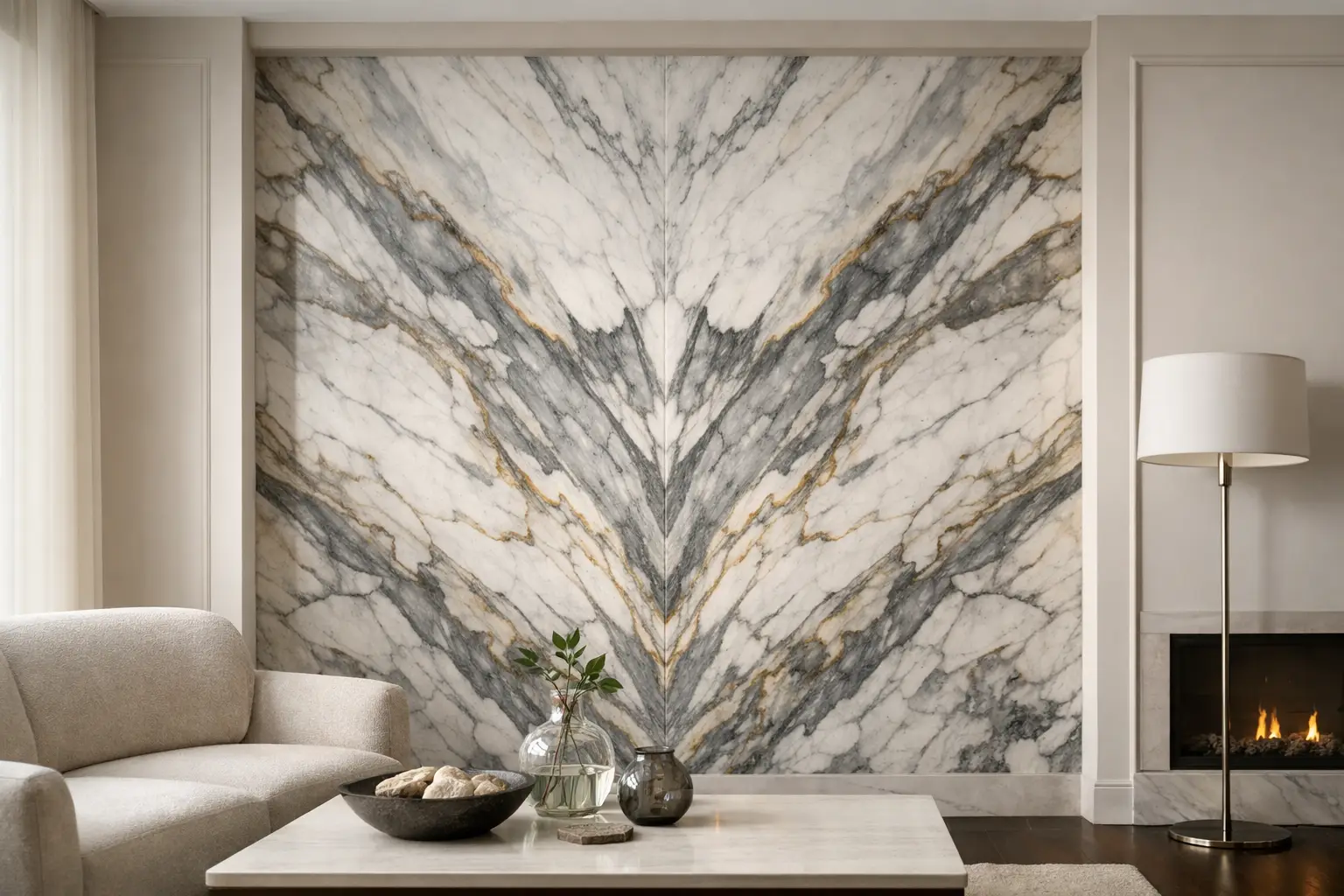
A single marble slab can possess remarkable movement. When its adjacent cut is opened like the pages of a book, that movement becomes a deliberate composition: veins meet at the centre, colour unfolds across the surface, and the wall acquires the presence of a work of art. Bookmatched marble wall panels are therefore not simply a luxurious finish. They are an architectural decision that gives natural stone its fullest expressive voice.
For a private residence, a hospitality interior or a distinguished public setting, the result can be calm and monumental or vivid and theatrical. The difference lies not only in the marble selected, but in the judgement applied from quarry block to final installation.
What Makes Bookmatched Marble Wall Panels Distinctive
Bookmatching begins with two consecutive slices cut from the same block. The slabs are positioned side by side with one turned over, creating a mirrored pattern. Veining that might appear incidental on an individual panel becomes symmetrical when the two faces meet. In four-panel arrangements, known as quad matching, the composition may extend into a grand central motif.
This effect is especially compelling in marbles with pronounced directional veining, crystalline depth or striking changes in tone. Statuario, Calacatta, Arabescato, Paonazzo and certain varieties of onyx can produce extraordinary results, but dramatic stone is not the only answer. A quieter marble, selected with discernment, can bring a measured sense of order to a refined interior.
The visual impact comes from nature rather than repetition. Unlike a printed surface, no two bookmatched installations are alike. Small variations in mineral deposits, fissures, clouds and colour are not defects to be erased. They are the record of the stone's formation and the reason a finished wall has authenticity.
Choosing the Marble Before Designing the Wall
The most successful bookmatched wall begins with the slab, not with a generic sample. A small piece can indicate colour, yet it cannot reveal the scale, rhythm or direction of the veins. Full-slab viewing is essential, particularly where the wall is intended as a focal point behind a reception desk, fireplace, bath or bed.
Designers often begin with an emotional intention. A white marble with fine grey movement may suit an interior shaped by light, proportion and restraint. A dark green, burgundy or black stone can create intimacy and gravity in a library, dining room or entrance hall. Honey-toned onyx, when backlit, can lend a bar or spa a soft, almost atmospheric glow.
Practical considerations must accompany this aesthetic choice. Some marbles are more porous or more sensitive to acids than others. In a dry feature wall, this may have little consequence. In a bathroom, near a basin or in a wellness area, the stone's finish, sealing system, joint detailing and daily maintenance deserve closer attention. Bookmatching does not remove the material's natural needs; it asks that beauty and use are considered together.
Vein Direction and Room Proportion
Veins can make a room feel taller, wider or more grounded. Vertical movement draws the eye upwards and is often suited to tall entrance spaces and chimney breasts. Horizontal movement may emphasise the breadth of a wall in a reception room or hotel lobby. A mirrored pattern with a strong central line can frame a fireplace, freestanding bath or sculptural piece of furniture with great precision.
Scale matters equally. A bold, open pattern can carry a large wall magnificently but may overwhelm a compact cloakroom. Conversely, a very fine-grained stone can feel almost silent across an expansive surface. There is no universal rule: the right decision depends on the room's dimensions, natural light, surrounding materials and the role the wall is asked to play.
The Craft Behind a Perfect Mirror Match
Bookmatching is often described as a visual technique, but its success depends on exact fabrication. The fabricator studies the slabs as a sequence, identifies the point where the veins will meet and prepares a cutting plan that accounts for the panel dimensions, joint positions, corners, service openings and any integrated lighting.
Even a narrow cut can alter the continuity of a vein. For this reason, the composition should be approved before fabrication proceeds. Vein maps, slab layouts and dry positioning allow architects and clients to understand how the finished wall will read at full scale. This stage is particularly valuable where a wall includes a doorway, tapware, electrical fittings or a bespoke fireplace opening.
The edge treatment also influences the final impression. Fine joints keep attention on the continuity of the stone, while carefully aligned mitres can give volume to returns and reveals. The support system must be selected according to panel thickness, substrate condition, panel size and the environment. Large-format slabs demand rigorous handling, appropriate mechanical fixing where required and experienced installation teams.
At Torchio Marmi, such work is approached as a dialogue between material knowledge and site-specific design. Stone is never merely cut to size. Its natural drawing is interpreted, protected and placed so that technical precision serves the intended atmosphere.
Where a Bookmatched Wall Belongs
A bookmatched composition is naturally suited to the places where an interior pauses and invites attention. In a residence, this may be the wall behind a fireplace, a dramatic stairwell, a double-height entrance or the principal bathroom. In hospitality and retail spaces, it can establish identity at reception, behind a bar or within a private suite.
It is also effective in quieter settings. A pair of marble panels behind a dining table may provide depth without demanding spectacle. In a study, a dark bookmatched stone can become a backdrop for timber joinery, bronze details and soft light. The aim is not to place marble everywhere, but to give it the space and lighting needed to speak.
Backlighting deserves particular care. Translucent onyx and certain marbles can be illuminated from behind, revealing a luminosity unavailable in conventional wall finishes. Yet lighting must be designed evenly, with accessible components and thoughtful heat management. Uneven illumination can distract from the stone's pattern, while an overly bright installation may lose the material's subtlety.
Finishes, Joints and the Presence of Light
A polished finish heightens colour and reflects light, often intensifying the visual drama of bookmatched stone. Honed marble has a softer, more contemporary appearance, allowing the veining to remain present without excessive reflection. Leathered or brushed finishes may bring tactility to certain stones, though they are usually chosen for their character rather than for a perfect mirrored effect.
Lighting should be tested against the actual slabs. Daylight can make white marble appear cool and crystalline; warm evening illumination may draw out gold, cream or rose undertones. Grazing light from the side can reveal texture and relief, while frontal light keeps the image more even. The surrounding palette matters too. Plaster, lacquered timber, metal and fabric can either amplify the marble's character or compete with it.
Joints should be planned, not hidden as an afterthought. In a two-slab bookmatch, the central joint is often integral to the composition. Peripheral joints may align with architectural lines, cabinet edges or shadow gaps to preserve visual calm. When panels are handled as part of the room's architecture, the installation feels inevitable rather than applied.
Care That Respects Natural Stone
Marble walls generally experience less wear than floors or kitchen worktops, but they still benefit from considered care. Dust can be removed with a soft dry cloth, while occasional cleaning should use a pH-neutral stone cleaner and minimal water. Acidic products, abrasive pads and ordinary bathroom sprays can mark polished marble or weaken protective treatments.
Sealing can help resist staining where the setting calls for it, but it is not a substitute for suitable cleaning or careful detailing. In wet rooms, ventilation and well-designed junctions are as significant as the surface treatment. Any restoration should be entrusted to specialists who understand the particular stone, its finish and the history of the installation.
A bookmatched marble wall rewards patience at the earliest stage: choose the slabs in person, study their movement under real light, and allow the composition to guide the room around it. Given that attention, the wall becomes more than a decorative surface. It becomes a lasting encounter with the deep time, colour and memory held within stone.