
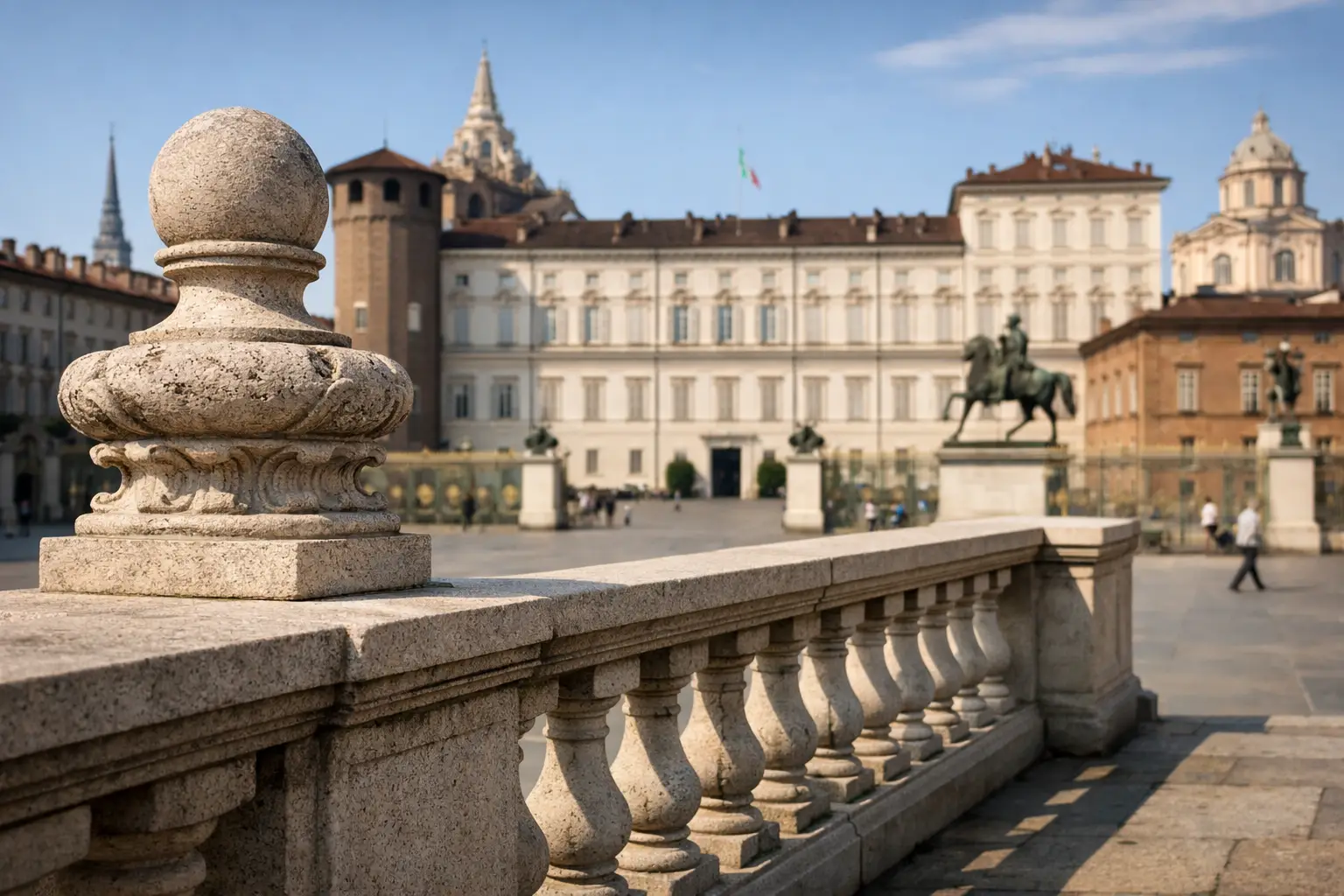
A piazza is never merely a paved surface. It receives the first footsteps of the morning, the measured passage of civic life, the pressure of public events and the gaze of those who understand that a historic city is built as much beneath the feet as above them. This Piazza Castello stonework case study considers the discipline required when natural stone must serve a place of exceptional architectural memory in Turin.
At Piazza Castello, material choices cannot be separated from their setting. The square stands within a dense dialogue of royal architecture, porticoes, façades and routes that have shaped the city’s public identity over centuries. Stonework in such a context has a responsibility beyond appearance: it must restore visual order without imposing a new language upon the place.
A civic surface with a long memory
Historic public spaces demand a different measure of quality from private interiors. A luxurious stone floor within a residence may be protected from weather and controlled by a small number of users. A civic square must accept rain, frost, urban pollution, maintenance regimes, heavy footfall and the continual movement of the city. It must do so while retaining proportion, legibility and dignity.
The work at Piazza Castello therefore belongs to a tradition of restoration in which stone is understood as both construction material and cultural record. Its texture, tone and laying pattern contribute to the atmosphere of the square. A surface that is too uniform can feel detached from its surroundings; one that is overly picturesque can become an imitation of age rather than an honest response to it.
This is where specialist stonework becomes decisive. The aim is not simply to supply slabs or setts, but to read an existing architectural grammar. Dimensions, joints, edges, drainage lines and the relationship between different finishes all require considered judgement. The completed surface must appear settled within its context, even though its technical performance rests on a highly deliberate process.
Piazza Castello stonework case study: material before method
Every successful intervention begins with the stone itself. Natural material carries variations of mineral composition, veining, porosity and colour that no industrial substitute can fully reproduce. These qualities are not imperfections to eliminate. Properly assessed, they are the source of authenticity and visual depth.
For a prestigious urban setting, selection must consider more than the first impression of colour. The stone needs to be compatible with the architectural palette around it, but it must also respond intelligently to use. Slip resistance, resistance to wear, water behaviour, frost tolerance and the way a finish softens over time all influence the final choice. A surface that looks impeccable at installation may be unsuitable if it becomes difficult to maintain or loses coherence after seasons of exposure.
There is no single material answer for every historic square. The correct decision depends on the original fabric, conservation requirements, intended traffic, substructure and the desired relationship between old and new work. Granite may offer particular resistance in demanding areas; selected natural stone may provide a closer visual affinity elsewhere. The essential point is that material selection and technical specification must be developed together, rather than treating appearance as a final decorative layer.
At Torchio Marmi, this material knowledge is informed by a craft heritage extending back to 1860. Such experience matters most where a project cannot be reduced to a catalogue choice. A stone’s value emerges from how it is sourced, cut, finished, positioned and allowed to belong to a specific place.
The importance of finish and scale
The finish of a stone surface changes its character profoundly. A polished treatment may heighten colour and reflection, but it is rarely the natural answer for an exposed public route. A flamed, bush-hammered, sawn or otherwise textured finish can offer greater grip and a quieter relationship with historic surroundings. Yet excessive texture may feel harsh underfoot or visually disruptive. The required balance is precise.
Scale requires equal care. Large-format elements can create composure and continuity, while smaller pieces may follow curves, levels and complex geometries more readily. Joint rhythm must be resolved in relation to the square’s wider lines of sight, not merely according to installation convenience. In an important civic setting, these decisions are perceived instinctively, even by visitors who cannot name them.
Craftsmanship beneath the visible surface
Stone is often judged by its face, but longevity is determined as much by what cannot be seen. A refined installation depends upon stable preparation, carefully managed falls, appropriate bedding and joints designed for the realities of climate and movement. Water is particularly unforgiving: where drainage is unresolved, even beautiful stonework can become vulnerable to staining, displacement or frost damage.
The execution of a large public stone surface is therefore a conversation between workshop and site. Fabrication must anticipate tolerances, edge conditions and the natural variations within each piece. On site, the installation team must respond to existing conditions without compromising the agreed composition. This is not a process that rewards haste. It asks for constant checking of levels, alignments and transitions, particularly where new work approaches historic thresholds or architectural details.
The most accomplished result does not advertise the difficulty of its making. Lines remain calm. Changes in plane feel intentional. The paving appears to have found its rightful place. Such apparent ease is the product of exact measurement, experienced hands and respect for the behaviour of natural stone.
Restoration without false antiquity
A central challenge in heritage work is avoiding two opposite errors. One is to introduce materials or details that are visually foreign to the setting. The other is to manufacture a false sense of age, as if restoration should disguise its own moment in time.
A more honest approach acknowledges continuity. New or renewed stonework should support the identity of Piazza Castello through compatible material, proportion and workmanship, while meeting present-day standards of safety and endurance. Subtle variation in natural stone assists this balance. It carries life and individuality without resorting to theatrical imitation.
This principle is particularly valuable for architects, public authorities and heritage stakeholders. The purpose of restoration is not to freeze a place outside time. It is to enable continued use with care, allowing a historic square to remain a living part of the city rather than an untouchable image.
Durability is an aesthetic decision
In high-quality stonework, beauty and durability are not separate ambitions. A poorly chosen or poorly installed surface will eventually declare its failure through cracked edges, uneven settlement, persistent staining or an uncomfortable walking experience. Conversely, a material selected for its performance but handled without aesthetic sensitivity can diminish the character of an important site.
The Piazza Castello example shows why commissioning teams benefit from involving stone specialists early. Early collaboration allows the relationship between concept, conservation obligations, fabrication and installation to be considered before visual decisions become difficult to revise. It also clarifies where compromise may be necessary. A finish that best echoes historic character may need adaptation for safety; a preferred format may need adjustment to accommodate drainage or existing levels.
These are not failures of vision. They are the practical refinements through which a vision becomes lasting architecture. In public work, permanence is not achieved by choosing the hardest material alone. It is achieved by understanding how every element will age, be cleaned, be repaired and be experienced by thousands of people over many years.
What this project asks of future commissions
For private estates, hospitality spaces, cultural institutions and civic developments, the lesson is clear: stone gains significance when it is treated as a complete architectural element. Its origin, finish, geometry, technical preparation and future care all deserve attention. This is especially true where the project seeks timeless Italian style rather than a short-lived visual effect.
The Piazza Castello stonework case study also reminds us that restoration is an act of confidence in the future. It requires the patience to choose well, the skill to execute precisely and the humility to let a great place remain greater than any individual intervention.
When natural stone is handled with that degree of care, it does more than cover the ground. It holds memory, gives order to movement and leaves a quiet promise that beauty, properly made, can remain at the service of generations still to come.